Jordan Tran Kean - The Interview

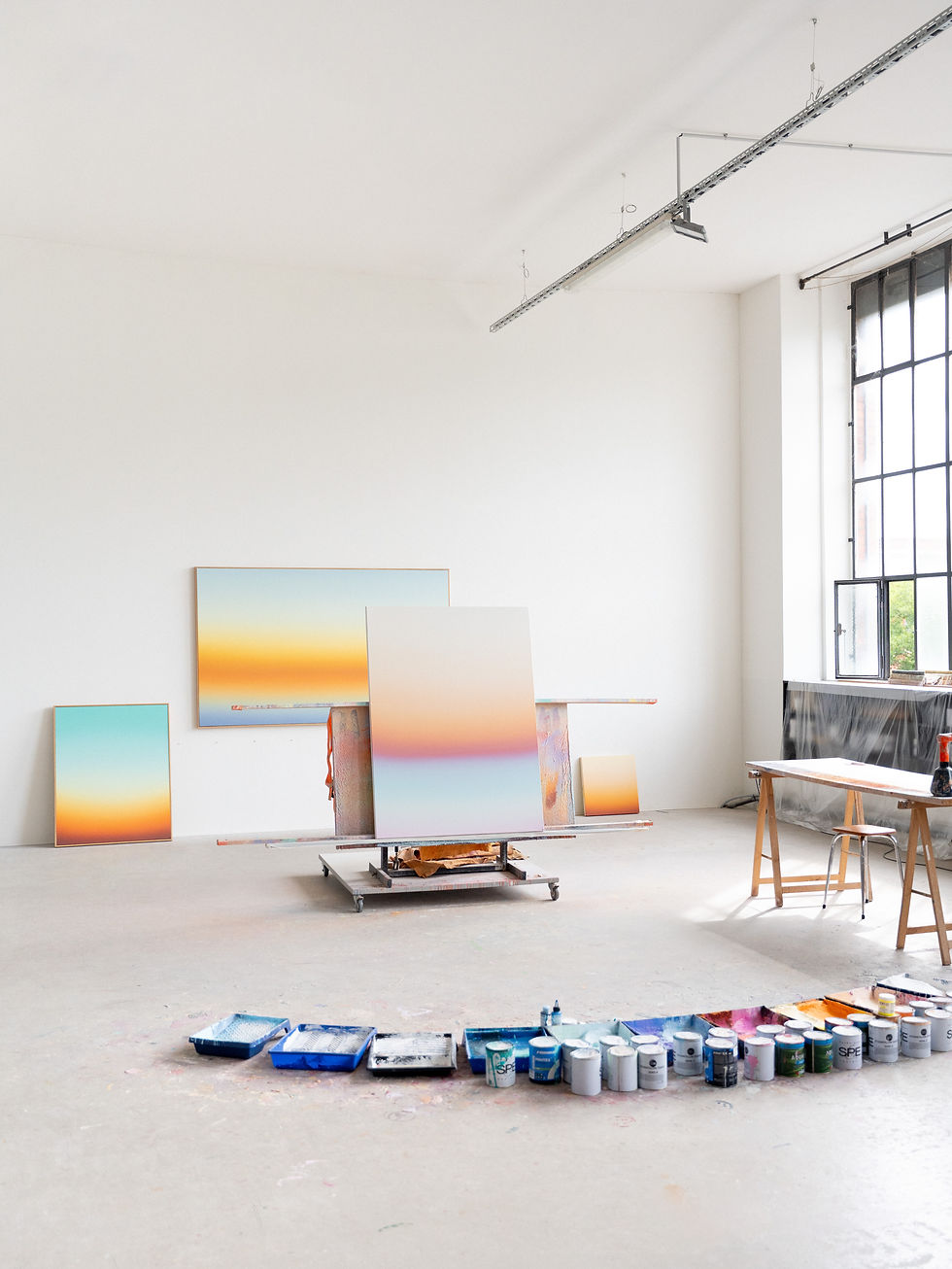
Jordan Tran Kean, Studio
SR You began your artistic journey through graffiti and urban space before gradually moving toward the quieter and highly controlled language of your current paintings. What did you discover through this transition, and what did you feel you were searching for when you moved from the walls into the studio?
JK Light is an integral part of my work. It is at the heart of my practice, essential and inseparable from my paintings. It helps me express what I feel, and this is something that can genuinely evolve from one period to another. In an exhibition, for example, you might encounter much darker paintings alongside much brighter ones. They correspond to different moments and different emotions.
I think a landscape can express an enormous amount, particularly because its light is constantly changing. Sometimes, I try to capture a very specific moment and draw inspiration from it. Light can transport us, make us experience a sensation, sometimes make us feel something without us even really knowing why.
So I try to make sure that light is always present that it draws the eye, speaks to us, transports us, moves us, and allows us to immerse ourselves in the work.
Even when I try to make the light in my paintings feel as natural as possible, I remain fascinated by the fact that there will never be anything quite comparable to natural light. Perhaps that is precisely what interests me: trying to translate something that is, by nature, constantly moving, and that can never be completely frozen in time.
SR Light seems to be one of the fundamental subjects of your work, even when it is never represented literally. Your gradients can evoke sunsets, skies, mist or distant horizons without describing a specific place. What does light allow you to express that a recognizable landscape cannot?
JK It depends a lot on the colors I use and on what I am trying to achieve. Some paintings begin to transform from the very first layer, while others have to be almost, or even completely, finished before they begin to convey what I am looking for.
It is all about vibration and balance. When I feel that everything makes sense, that there is nothing left to add or remove, the work begins to exist on its own.
What fascinates me most, precisely, is when the painting begins to live through the eyes of other people. That is when something happens. The gradient is no longer simply the result of a gesture or a technical process; it becomes an experience for the person looking at it.
SR Your gradients are extremely precise and require a very patient process of layering and blending colours. When does a gradient stop being merely a technical result and begin to carry an emotional meaning for you? Is there a moment during the process when you realize that a work has finally reached the right balance?
JK A painting can begin with a landscape that made me experience a particular emotion or moment. Sometimes it can also come from a photograph that really moved me, or simply from an atmosphere or a sensation.
I am especially sensitive to the light that a landscape can give off. It becomes even more incredible when you realize that this light changes every minute.
Every painting has its own story, even if that story is not necessarily visible or explicit in the final result. Each person can then project their own interpretation onto it.
That is something I find incredibly fascinating: the same painting can evoke completely different sensations depending on the person looking at it. In a way, I think that is also what allows a work to go beyond its own starting point.

SR Your paintings often exist somewhere between abstraction and landscape. They may suggest a horizon or an environment, but ultimately seem to describe an inner atmosphere rather than a geographical place. Do you consider your works landscapes, or are they closer to emotional spaces?
JK Absolutely. And once again, I think your observation is very relevant.
Contemplation is probably one of the things I try to emphasize most in my exhibitions and installations. Taking the time to feel, to experience, to slow down, to breathe, or simply to relax… I could keep searching for words for a long time to describe these sensations.
That is something I try to create through my paintings: a moment of suspension. A kind of weightlessness in which you can paradoxically feel free. Not immediately trying to understand or analyze, but simply enjoying the moment and allowing yourself to let go.
There is also, for me, an essential almost indispensable notion of beauty. Beauty reminds us that we are not machines, but sensitive beings. Looking at a work of art that we find beautiful can be a way of reconnecting with ourselves, with our emotions and with our sensitivity. In a way, it is also a sign that this sensitivity is still present within us, that our mental and emotional lives still have room to exist. If someone stays in front of one of my paintings for a few moments without feeling the need to immediately move on to the next one, then I think something is already happening.

SR There is a strong sense of silence in your work. In a visual culture increasingly dominated by speed, information and constant stimulation, your paintings seem to ask the viewer to slow down and simply remain with the image. Is creating a space for contemplation something you consciously pursue
JK I was immersed in graffiti culture for a long time without really knowing museums or foundations. I discovered quite late that beyond graffiti, there were much broader worlds within art.
I will always remember the incredible feeling I had when I first saw a work by Pierre Soulages. That light within the black was simply sublime, and I was fascinated by his work for a long time.
A little later, some people saw a connection between my work and the paintings of Mark Rothko. At the time, I did not know him at all. It was only after seeing his work in person that I understood the familiarity I could feel with his approach: the way he brings out such a particular kind of light, one that almost allows the color itself to be transcended.
There is something in his work that goes beyond color itself. His paintings can seem extremely simple at first glance, yet they create a sense of presence, depth and emotion that has had a strong impact on me.
On the other end of the spectrum, or at least within a very different visual language, I am extremely interested in Felipe Pantone’s installations. His approach to color, perception, movement and space fascinates me.
These are all very different artists, and that is precisely what interests me. Each of them has a very strong way of making color exist and of transforming our perception of space.
I think my influences also come from all these differences. Graffiti is part of my history, and then there is everything I have discovered through abstract and contemporary art.
I am obviously not trying to reproduce what these artists do, but rather to understand their vision, what their work can provoke in me, and what I can take from it and bring into my own practice.

SR Your work has been associated with Color Field Painting and with artists interested in light and perception, while your background in graffiti brings a very different visual history into your practice. Which artists, experiences or visual encounters have most profoundly transformed the way you understand colour and space?
JK I usually start with a preliminary idea. I have a feeling, a range of colors in mind, something I want to bring into existence. Then I gradually let intuition take over.
I work with the colors through multiple layers until I reach a point that corresponds to the emotion I am trying to convey. It is difficult to explain because, over time, it has become very instinctive.
I am asked this question quite regularly: how do I know that two colors will work together? And ultimately, I cannot really explain it. Today, I see colors in a fairly clear and natural way.
Sometimes a combination of colors may seem impossible to someone else, whereas for me, as soon as I see it, it immediately works.
I think ten years of working with gradients have allowed me to develop this intuition. I have accumulated an enormous amount of experience, and today I am able to trust my eye much more.
SR Colour in your paintings is subtle yet highly charged with meaning. A small shift in tone can completely change the atmosphere of a canvas. How do you decide which colours belong together, and do you approach colour intellectually, intuitively, or through a combination of both?
JK I would like to keep a common thread running through my work. The gradient has, in a way, become my language, and I want to preserve that identity, even as the way I use it continues to evolve.
What interests me today is seeing how far I can take this language without losing the emotion at its origin.
For some time now, I have been particularly interested in movement. For almost ten years, my gradients were very straight and calm, with a certain sense of stability. Since I started introducing movement, I have found enormous pleasure in seeing what it creates.
It introduces a rupture, a contrast that I really like. I enjoy this opposition, this sense of complementarity between something very calm and something more vibrant.
I think that is where my current research lies: creating a rupture without losing the continuity of my work, introducing movement without losing the sense of contemplation that is so important to me.
Painting more instinctively, allowing myself to let go more, and seeing where that can take me.

@All images courtesy of Jordan Tran Kean.