Per Adolfsen: Drawing, Nature and the Act of Seeing
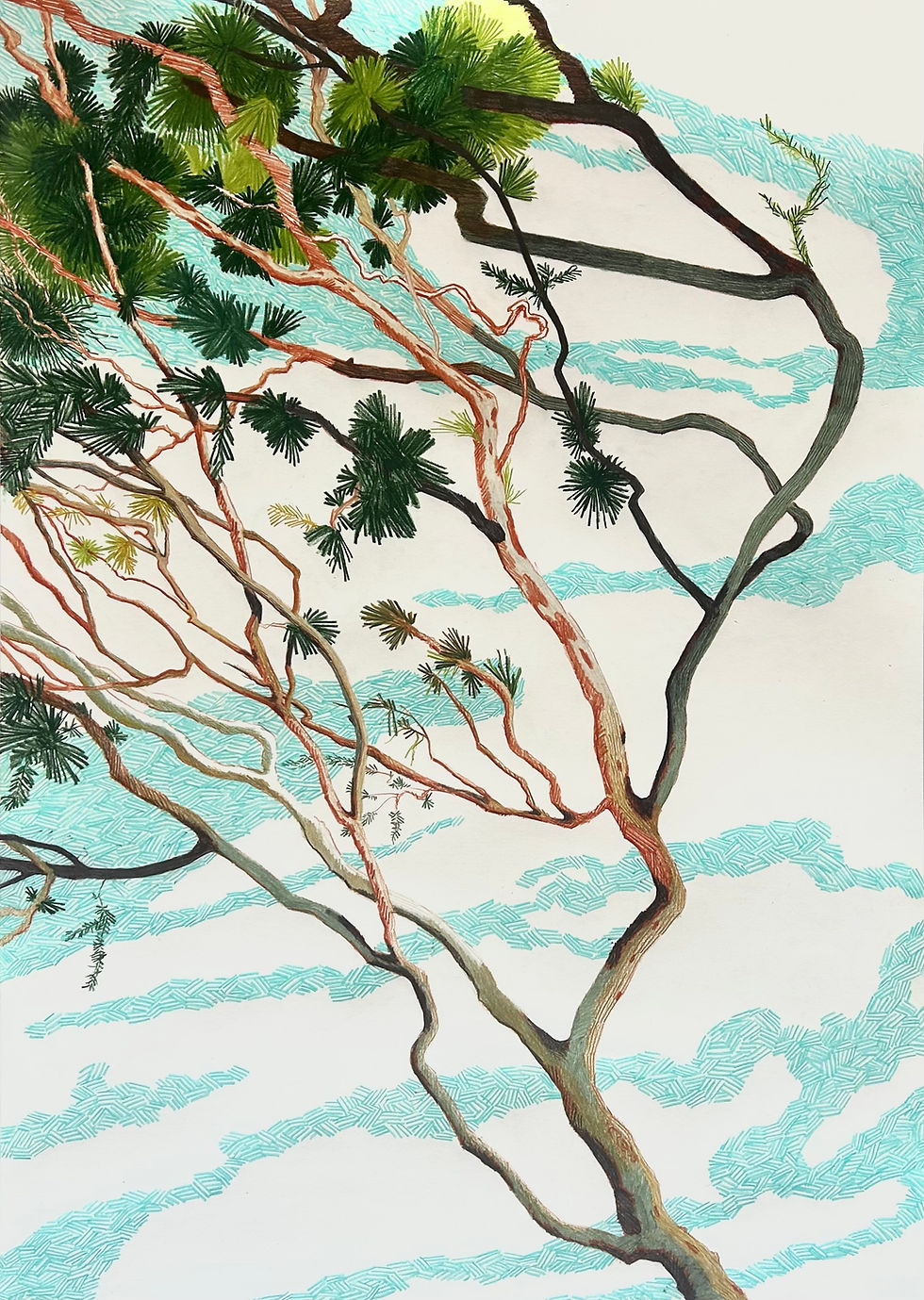
Born in Odense in 1964, Danish artist Per Adolfsen has developed a practice deeply rooted in drawing, observation and the natural landscape. After exploring different artistic languages throughout his career, including abstraction and surrealism, Adolfsen returned to the direct study of nature, working outdoors with pencil and paper and transforming his observations into larger works on paper. His landscapes are not simply representations of places, but investigations into perception, space and the relationship between human experience and the natural world. His practice is grounded in a deliberately direct relationship between eye, hand and reality, avoiding photographic references in favour of an immediate encounter with the landscape.
In recent years, this approach has become central to Adolfsen’s work, leading to exhibitions in cities including New York, Paris, Brussels and Toronto. In the following conversation, the artist reflects on his return to drawing, his daily relationship with nature and the importance of looking directly at the world around him.

SR You have described your recent return to drawing and to the natural world as a deeply personal moment in your artistic journey. What led you back to this way of working, and what did you rediscover through it?
PA I returned to the starting point of everything I have done later in life by returning to where I began as a boy: going out into the landscape and drawing my surroundings - the forests, the fields, and the canal near where I lived.
Already at the age of thirteen, I had a strong sense that this was what I was meant to devote my life to, simply because it was such an integral part of my everyday existence.
When, in 2017–18, I returned to that starting point and began going outside every day with a small sketchbook and a pencil, it was for personal reasons that had nothing to do with art. I resumed the practice without thinking about whether it was art at all. It was simply about going outside. Finding a sense of peace in the landscape around me. And finding peace in the sensation of the pencil moving across the paper. I imagined that I would do it for a few months, as a small project - a way of reconnecting with where I had come from, with the thing that had originally set in motion the formation of what I had become over the years. Unexpectedly, the daily act itself became essential to my entire existence. It was no longer a project, but a new way of living.
The notion of art gradually became less important. Suddenly, it was about something more fundamental: an existential feeling of simply being myself, naturally and completely. It was not about art. Through this repetition, through looking every day - looking closely and with complete concentration something began to change in the way I observed the world. Lines and sequences began to reveal themselves as interconnected. Logical. As parts of one coherent system: the system of nature. This made me increasingly aware that I, too, am a part of nature. A pattern. A sequence. I became almost dependent on these studies and on what they were doing to me as a human being.
And so I continued.

SR Your works begin with direct observation of the landscape, through drawings made in nature, before being developed further in the studio. What does working directly from the landscape allow you to see or understand that you might not discover through photographs or other forms of reference?
PA I developed a set of principles for myself—dogmas, in a sense. Restrictions on what I was allowed to do and what was forbidden within my practice. I needed these limitations to reduce the number of possibilities, so that I would remain on the path I had chosen to follow. There were around ten rules that I had to adhere to.
One of the most important was that I could not use photographs as a starting point.
After all, the act of drawing in nature was the very essence of what I was doing. Over time, I have thought a great deal about why this distinction is so important to me—why working directly from reality matters so much more than working from a photograph.
Experiencing reality through a photograph is an enormous limitation compared with the way we, as human beings, actually perceive the world around us. When we draw a subject from a photograph, we reduce our perception of reality to something flat and rectangular, without the dimension of space.
In our lives, when we use our eyes and our senses, we experience reality spatially. We are constantly in motion. Our eyes are constantly moving, registering countless small impressions as we observe the world around us.
We look at the object we are drawing. We may be sitting still while we do so, but in reality everything is always moving. And even the things we are not directly looking at—the ground beneath us, for instance, or the sky above us we still sense them. We are also aware of what lies at the edges of our field of vision.
So, when we draw on location rather than working from photographs, we are not making a drawing of an image of reality. We are drawing reality itself, and the space as we experience it.
That allows us to reach an entirely different dimension through the act of drawing directly from what is physically before us.
My own logic is that drawing not from a photograph, but from the reality we are actually inhabiting, gives the act of drawing a deeper meaning.
There are certainly enough images in the world. We are constantly bombarded with them. We do not lack images.
What we do lack is an engagement with space and with the reality we inhabit. And this, to me, is what gives art and drawing greater relevance.
Perhaps, in a time of AI and rapidly developing technologies, this has become even more important. As artists, we are asked to offer our own understanding of reality.
For me, that means looking at the world and studying it through our own perception of reality, through my own perception, through the full range of senses that I pocess, rather than through technological aids.
Per Adolfsen works are right now on show at the Houston Untitled with Nino Mier Gallery


@All images courtesy of Per Adolfsen