Malwin Faber

"Nur leicht versetzt", 2025, acrylic + spray paint on canvas, 160 × 140 cm
Modulations
In the series “Modulations”, Malwin Faber brings forth a painterly language in which calculated structure and painterly spontaneity merge and resonate. Much like in a musical improvisation, the artist takes up motifs and impulses from previous works in each new painting, varying, breaking, and condensing them anew. Unintended material dynamics are consciously integrated into the painting process, opening up unexpected visual outcomes that gradually build complex pictorial spaces layer by layer.
His painting thrives on contrasts: gestural movement meets precise grids, intricate textures encounter clear geometry. Faber uses the technique of monotype not merely as a printing method but as a painterly tool, comparable to an effects unit that distorts, bends, or vibrates a guitar sound without denying its origin.
Each painting resembles a modulation: it shifts the tone, creates tension, generates friction and spaces in between, only to resolve them again. This creates a dialogical visual flow, in which structure and spontaneity, rhythm and surface interweave into a multi-layered composition.

"Interventions", 2026, acrylic + spray paint on canvas, 140 × 120 cm
Resonance Frequencies
Structure and static on the one hand, whirls and dynamics on the other: Malwin Faber combines opposites in his paintings that were considered incompatible in modern art: geometric and gestural abstraction. While one represents objective order, the other embodies the artist's subjective self-expression.
From the Russian Constructivists to De Stijl, from Kazimir Malevich to Theo van Doesburg, the idea of a metaphysical principle is connected with geometry. Artistic and cosmic order correspond to each other in geometric basic forms, representing the blueprint of the world. On the other hand, gestural abstraction, from Kandinsky's "Improvisations" to Jackson Pollock's "Drippings," refers to the artist's inner self, seen as expressive and emotional.
Faber breaks down these attributions. Geometric grids and diamonds are disrupted by expressive brushstrokes, which are in turn intersected by the geometric structures. The order appears chaotic, and chaos becomes peculiarly organized. Mathematical precision and artistic improvisation, the rational and the irrational, are irreversibly intertwined.
This effect is enhanced by a spatial arrangement that blurs the foreground and background: the parallel image planes penetrate each other, causing what should be at the bottom to appear on top and vice versa. Faber achieves this effect by masking individual areas during the painting process and later revealing them.
As a result, the gestural brushstrokes appear strangely devoid of meaning. They no longer point to spontaneous artistic self-expression, but become literally empty forms, revealing the layers underneath. Their internal structure does not follow the bristles of the brush, and the filling form contradicts the outer contour. Instead, they seem like excerpts that allow a glimpse of structures that were visibly created differently.
Faber outlines these brushstroke forms, adding contrasting bright and dark colors to emphasize their edges, making them appear as if floating on the picture surface through shadow joints.
This deconstruction of the brushstroke as a guarantor of authenticity for immediate spontaneous self-expression, an expressive, "genuine," emotional painting, is accompanied by a destabilization of the geometric structure that organizes both the picture surface and the pictorial space. Diamonds and grid points are overlaid and crossed by the brushstrokes, at times appearing to cancel each other out, yet also highlighting one another.
"Resonanzfrequenzen (Resonance Frequencies)", the title of this exhibition, encapsulates this oscillation between static and dynamic, order and chaos, foreground and background, space and surface, subjective gestural self-expression, and objective geometric structure: the "frequency" describes the speed of a repetitive vibration that encompasses both the geometric grid and the gestural form.
Not only are the geometric structures regular, but the gestural forms also oscillate around a center, like the swing of a pendulum, and are sometimes even mirrored, as in a Rorschach test.
The ideal geometric blueprint of nature as a symbol of cosmic systematicity also manifests itself where the irregular becomes peculiarly regular: the seemingly orderly but not uniformly symmetrical growth of the "agave" appears like a nature-transformed artistic formation of gestural brushstrokes, mirrored like in a Rorschach test.
Rule and deviation, system and variation, point to the creative potential of a constantly reinventing nature as well as an art that is truly creative, akin to this imagined nature. Around this center, the two ostensibly opposing systems of the geometric and the gestural sway together, responding to each other and inspiring one another in their formal diversity as well as their rhythmic similarity; they create a reciprocal resonance.

"Flip Flop Drop", 2025, oil + acrylic + spray paint on canvas, 80 × 70 cm

"Fading Axis", 2026, acrylic + spray paint on canvas, 80 × 70 cm

"Peak", 2025, acrylic + spray paint on canvas, 100 × 90 cm

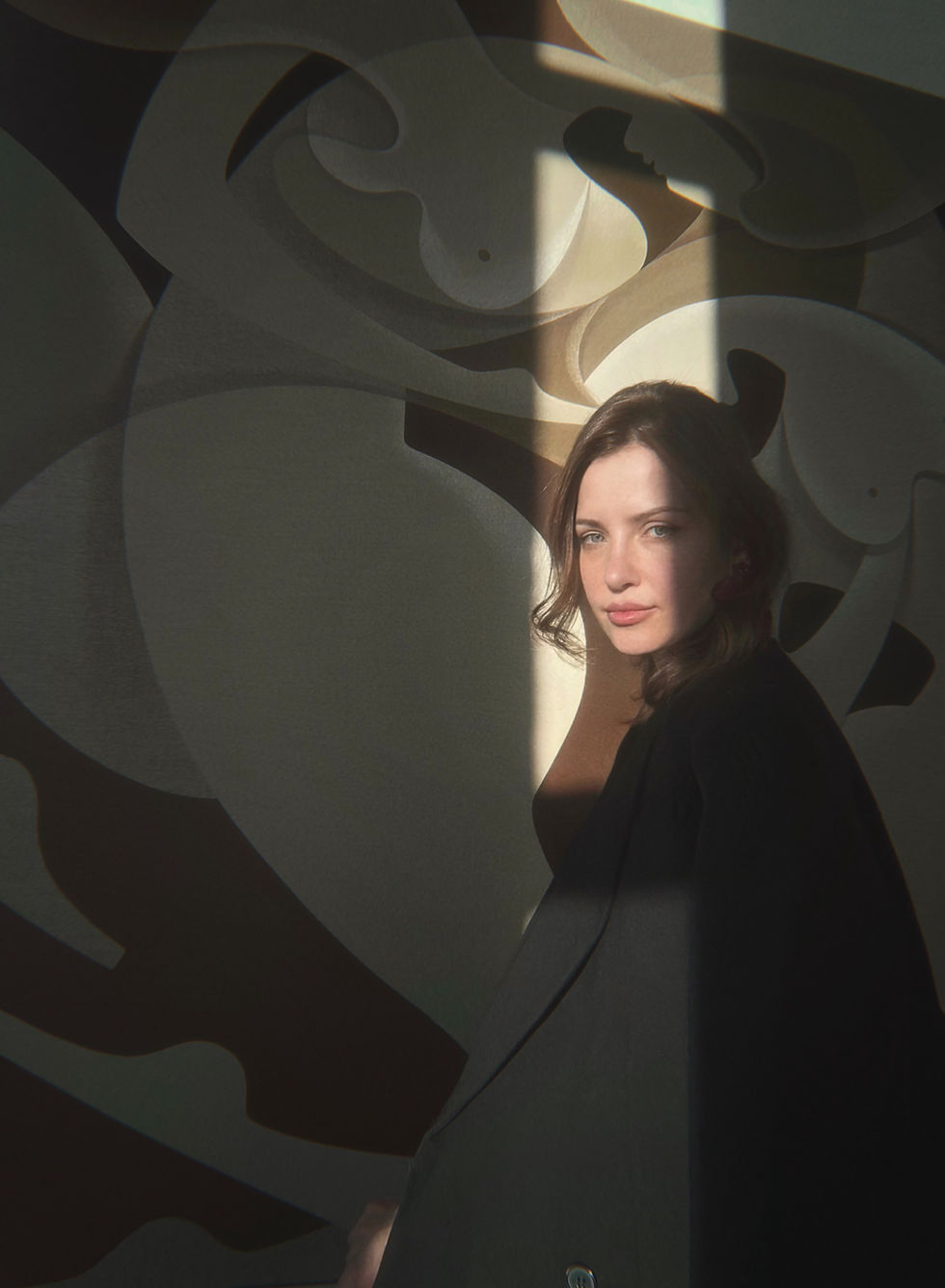
Portrait by Jasmin Gritzka
@All images courtsey of Malwin Faber