Matt Carey-Williams - The Interview

Portrait of Matt Carey-Williams outside his space on Porchester Place, London by Alexei Izmaylov © Matt Carey-Williams / Showpickle
SR You began your career at Sotheby’s in 1997, subsequently working across auction houses and internationally renowned galleries, including Gagosian, Haunch of Venison, White Cube and Victoria Miro. Looking back on your journey, which experiences or encounters have most profoundly shaped your understanding of the art world? How has your perspective evolved from those early years to your current independent practice?
MCW I have lived three lives in the ‘art world’ (for want of a better word) over the past thirty years. Auction house Specialist; gallery Sales Director and, most recently, independent gallerist, curator and writer. A + B = C. Sort of.
Take Figure ‘A’. My time spent at Sotheby’s in London and New York at the beginning of my journey was, unquestionably, the most influential chapter on my career. I had the pleasure of working with some incredibly talented people there across all sectors of the business, many of whom invested in me the work ethic I still subscribe to today. There I learned how to handle objects and, perhaps more importantly, people. I learned how to scrutinise and interrogate a work of art, wringing from it every drop of its history, significance and quality whilst researching, writing, displaying and eventually selling it. I also learned to then take that expertise and foreground it in every conversation I had with collectors about the post-war and contemporary art I was handling, but also about art in general. Sotheby’s taught me that expertise was – and should always be – my biggest ‘weapon’ when selling art and the only way to source that arsenal was to spend time with as much art as possible – in museums, galleries, art fairs, collectors’ homes and other auction houses. Which I still believe, and still do, to this day.
Now Figure ‘B’. Galleries taught me how to build longer-lasting, more fertile commercial relationships with clients. Auction houses feed off the clock ticking; good galleries nurture a more measured, thoughtful pace between the collector and the object, principally because the gallery has – at the core of its objective – the success of the artist. That success is calibrated not just commercially or financially but reputationally. Even though I have worked for some very big, ‘blue-chip’ galleries, every one of them focussed on ‘placing’ not ‘selling’ art; gave me time to nourish a wider perspective with my clients; rewarded my active relationship with a gallery artist outside of the usual ‘sales commission’ structure. Auction houses promote art and competitive acquisition; galleries foster artists, careers and a deeper, more sensitive understanding and appreciation of practice. Both are important.
Does A + B = C? Certainly, I keep to many of the ‘rituals’ I had instilled in me when I was but a wee lad starting out in this industry. I still treat the act of selling as one that tries to unveil what motivated an artist and, equally, what motivates a collector to collect – and then try to blend those two motivations into a placement. But ‘C’ is not just an amalgamation of my two previous trajectories. I now spend considerable time doing much more than simply sourcing or selling art (which was very much the thrust of my career for 27 years). I now write much more; work with artists far more closely and curate exhibitions – something I feared I would never have the chance to do. I finally feel like I have a voice, albeit a bit of a mouth-full-of-Wotsits mumble but one that satisfies my long-standing desire to create. This latest (and, please God, make it my last) chapter has come to fruition not in spite of, but because of the deep foundations I dug out for it in the trenches of my prior, extended experience (and some success) at auction houses and ‘blue-chip’ galleries. The time spent there inspired and empowered me to take that deep breath and jump in at the deep end of self-employment. I only wish I had been brave enough to do it earlier.
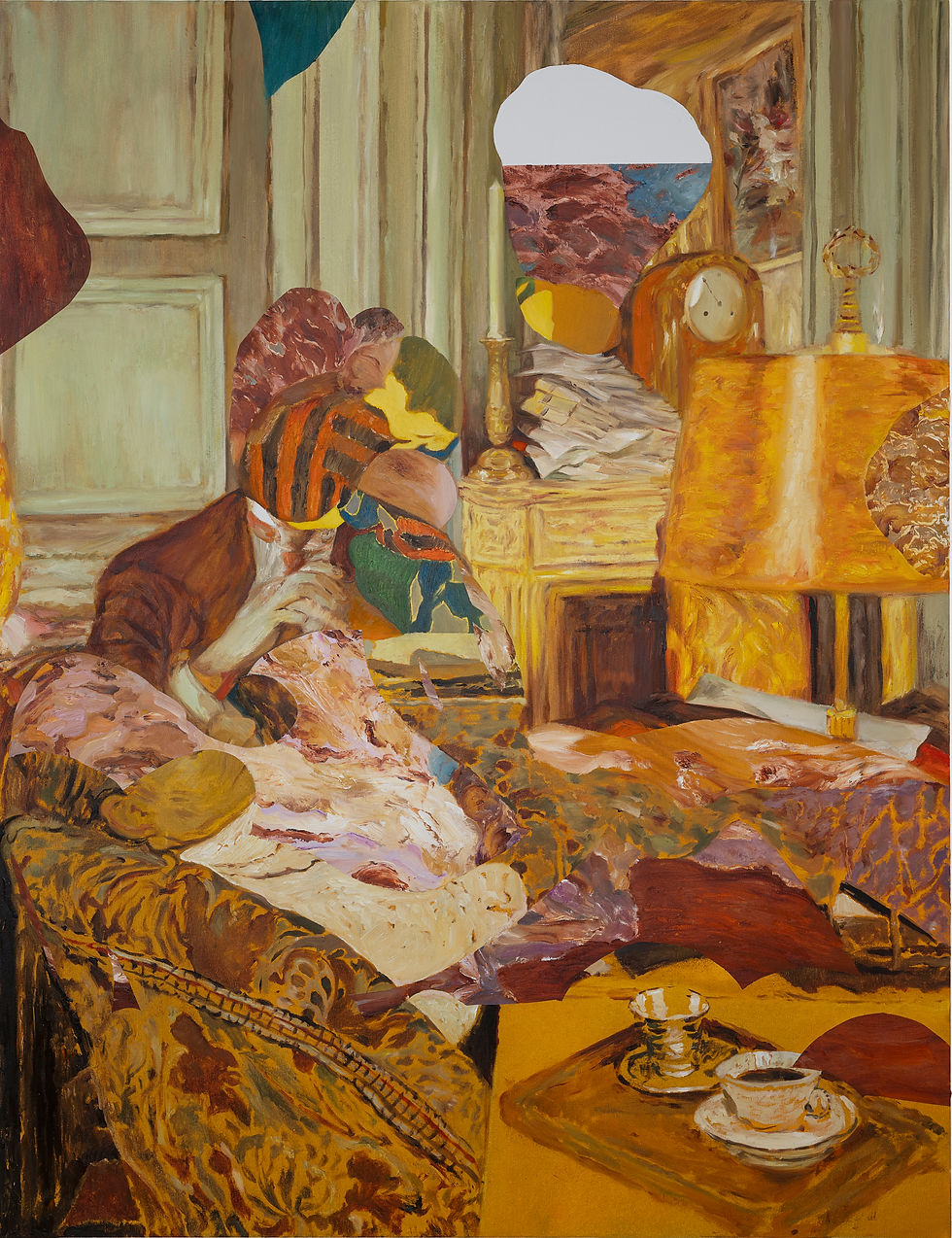
Dean Fox, Keeping the Books off the Shelf II (2026, Private Collection), © Matt Carey-Williams / The Artist, photography by Showpickle
SR Throughout your career, you have worked closely with artists, collectors, gallerists and institutions. In an industry where personal relationships often play a decisive role, how do you approach building trust and maintaining meaningful professional connections? What have these relationships taught you about the less visible dynamics that shape the international art world?
MCW Trust is, very simply, a two-fold action: saying what you are going to do and then actually fucking doing it. Trust is germinated by inspiration and the promise of collaboration and cemented only by delivery. That’s all there is to it which is why gaining trust is so bloody difficult. For a collector or artist to trust me I must think outside of the orbit of any specific conversation or set of circumstances. Trust is about giving the right advice to the artist or client, even if it is detrimental to you as a seller or gallerist in the short term. Trust is about paving the long way home; it does not allow for or reward short cuts. Massaging relationships requires time and commitment, thought and enterprise, but that cannot be allowed to overwhelm you or, indeed, the client or artist. A much-respected dealer-collector once said to me that the two greatest luxuries in life are time and space. Give both of those to your professional relationships – to you and your audience – and you will quickly establish a measured, paced bond and common interest based on trust. Then you really can fly to the moon with each other.

Theodore Eirera-Guyer, Snow (the difficulty of knowing), © Matt Carey-Williams / The Artist, photography by Matt Ashford Photography
SR After years of working within established galleries, you developed your own independent curatorial project, creating a platform through which to explore artists and their work from your own perspective. What inspired this transition, and how has it influenced your approach to exhibition-making? What opportunities does independence offer when it comes to discovering artists, establishing new dialogues and engaging audiences?
MCW You only really open your own space because there is little germ inside you – call it ego, call it anxiety – that needs to share a bit of what charms, seduces or annoys the fuck out of you about the world we live in. I opened my space because I didn’t want to bugger off to Shady Pines and live the rest of my life ‘what-iffing’ about what could have been. So, I went for it and, in truth, I haven’t looked back since. Carving out my own creative license is one of the best decisions I ever made: I am empowered to work with whom I like, how I like, where I like. That is the gift that keeps on giving but one that needs constant management: independence does indeed come with a price. My decision to pivot away from more established artists and focus much of my energies on those who have just emerged (again, for want of a better word) is as much coloured by my, and my husband’s own collecting proclivities as anything else. I wanted to operate in a dynamic space that both excited and challenged me, but also one which afforded me plenty of opportunities to discover, display and disseminate contemporary art and artists that I would want to live with myself. Unsurprisingly, being independent has only increased the number of opportunities to meet, engage and work with such artists and, more so, those that are passionate about collecting their art. I guess being the ‘new kid on the block’ is one thing (everyone loves the ‘new’), but arriving with a mop of grey hair and a cobweb of wrinkles etched over my face, earned over many years of working in the ‘art world’, is another. I came into a space and community usually occupied by younger people, zinging with ideas and ambition. I entered with just as much brio as my then 52-year-old ass would allow, but couched by years of experience and – to be frank – a black book with some pretty significant digits and emails in there; collectors many of whom continue to work with me today, supporting the project and my programme. This little differentiation has really propelled my efforts to meet and work with the artists I find interesting and which I believe have ‘the legs’ to go the distance. The key point to make is that I remain as thrilled as ever to work with a community of artists I would only ordinarily have had access to as a collector. My collaboration with them has – and continues to – reward me in ways I never thought my career ever could or would.

Installation shot, Episode I: Bump at No. 9 Cork Street, 7 – 23 March 2024, © Matt Carey-Williams / The Artists, photography by Ben Westoby
SR When you encounter an artist or an artwork for the first time, what captures your attention and encourages you to look more closely? How do instinct, research and personal sensibility inform your decisions? How do you distinguish between an artistic practice that resonates with you in the moment and one that you believe has the potential to develop into a meaningful and lasting trajectory?
MCW Like many people in our industry, I am often introduced to a young artist’s work because of a word-of-mouth, friendly recommendation; a chance meeting (usually at one of my openings) between us or, increasingly likely, having seen something on social media that tickled my fancy. When I am fortunate enough to make a studio visit, I go in with zero expectations. I let the art speak to me first and then the artist. I try not to speak. ‘Seeing’ art does not initiate just an ocular response in me; I must feel moved by it – feel it in my guts - to want to learn more about how and why it was made like that. Intuition therefore plays a big part when I first receive a body of work, however, I am also very drawn to artists who can articulate clearly - even with a pepper of poetry – the manner and meaning of their making. There are many who presume that my job is to gamble on these artists – show them in the hope that some of them become ‘big’. That is not the case. The gamble was made a long time ago when, as a young man from a working-class family, I decided to stop working and go to university to study art history. My endeavour is simply to work with artists that I believe are good; that make art I would want to live with. Focusing on your own determination and calibration of quality, without having to look at it through lenses of price or investment, is the only way to approach artists – whether they are 25 or 85. I start there and let all the other inevitable dialogues about ‘value’ unfurl, then entangle themselves. I do not think it is possible to go into a dialogue with a young artist and believe you can somehow ‘read’ their future. You can’t. You can only assess whether you like the work enough to want to work with it. If that box gets ticked, then go to work. It’s all an artist wants from you.

Installation shot: Episode III: Chris Huen Sin-kan, The Path and The Fog, Part I at The Bomb Factory, Marylebone, 2 – 13 September 2025, © Matt Carey-Williams / The Artist, photography by Showpickle
SR Every professional in the art world develops a personal set of references, affinities and convictions. Which artistic practices, movements or ideas are particularly compelling to you now, and how have your tastes evolved throughout your career?
MCW I have an eclectic taste when it comes to art. As a ‘fan’, I love fifteenth-century Netherlandish panel painting (van der Weyden, van Eyck, David, etc.) and the Baroque in many of its guises but especially as adumbrated in seventeenth-century Holland and Flanders by the likes of Rembrandt and Rubens, particularly. I love painting above all other disciplines, however, I don’t really tune in to ‘movements’ or ‘ideas’. I am drawn to a surface and a process before an image and any subsequent index that informs it. I think in a tactile way, which explains my desire to ‘feel’ art, rather than just ‘see’ it. In truth, the palette of my taste buds has pretty much remained consistent throughout my career: I like marks that evince something of the flux of being (it doesn’t matter whether they are figural or just gestural) and I like to be dazzled by their choreography into arabesques of rage and/or rapture. I just love paint – the goo and the smear and the slip and the fucking big blob of it all.

Lauren Brown, Subject (2026, Private Collection),©Matt Carey-Williams/The Artist, photography by Showpickle
SRThe ways in which art is discovered, discussed and collected continue to evolve, shaped by digital platforms, social media, international mobility and changing generations of collectors. From your perspective, what are the most significant transformations currently taking place in the art market? How can galleries and independent art professionals preserve the intellectual and cultural value of artistic practices while navigating the commercial realities of the industry?
MCW My friend, Valentina Castellani, has just published an excellent book called Trading Beauty in which she chronicles the development of the art market from ‘the altar to the gallery’. Valentina pretty much covers 800 years of the history of the art market in her book, and she told me recently that she could write another one – just as long – that would just about cover all the developments made since 2000. Email; digital imagery; the conflagration of art schools; a bigger and richer and more global middle class and their new understanding of ‘luxury’ as ‘status’. That’s your starter for ten. Then factor in social media – specifically Instagram – and everything gets exaggerated a thousand-fold. What was a sound is now a noise; a boutique now a fair now an online platform with hundreds of thousands of participants. The infrastructure that supports art and artists has expanded exponentially over the last 25 years. Has it afforded better conditions for making, marketing, selling and exhibiting art? Are artists more supported creatively or financially as a result? I don’t know. All I can do is what any small gallery or curatorial project can do which is to focus on your collaboration with artists, your presentation of their art and the subsequent (hopefully) elegant placement of those objects into happy homes or institutions. That is, genuinely, all any commercially driven enterprise in the ‘art world’ can do. By having the show; by showcasing the artist; by connecting them with a wider community of art buyers and lovers with exhibitions, texts, online or social media exposure, you are, ab initio, contributing to the cultural value of that artist and their practice. You are still doing that if you sell everything or nothing in their show. I don’t see any difference as a gallerist between commerce and cultural significance when trying to sell a work of art for an artist. Both pursuits go hand-in-hand.

Installation show, Scene VII: Hair, 21 November 2024 – 18 January 2025, © Matt Carey-Williams / The Artist, photography by Reliant Imaging
SR Through your Scenes and Episodes programmes, you have developed different exhibition formats, dedicated both to presenting individual artists and to creating dialogues between artworks. What directions would you like to explore in the coming years? Are there particular artists, cultural contexts, institutional collaborations or curatorial questions you are especially interested in pursuing? Ultimately, what would you like audiences to take away from these experiences?
MCW I want to continue putting on exhibitions that make people stop and think just a little bit about what the actual fuck is going on in our world. A lot of what and who I choose to work with is glittered with a little sprinkle of political ‘T’. I remain passionate about painting and emerging / emerged artists and will continue to devote much of my energy to those spaces. I have also recently introduced a representational element to my structure and so will be spending more time focussing on Sara Birns, Lauren Brown, Nada Elkalaawy, Theodore Eirera-Guyer and Dean Fox. The most important thing for me is that I continue to smile, love what I do and be inspired by the people and artists I work with. If all I do is check on that every day then, all the gods willing, we should be fine.

Sara Birns, Circle of Love (2026), © Matt Carey-Williams / The Artist, photography by Showpickle
SR For a young art advisor entering the profession today, building relationships with artists and collectors while developing an independent perspective can be both exciting and challenging. Based on your experience, what do you consider essential to building a credible and lasting career? Beyond commercial expertise and networking, which qualities, principles or habits would you encourage the next generation to cultivate to recognise genuine artistic potential and make a meaningful contribution to the art world?
MCW There is no such thing as a ‘young art advisor’. If you’re 25, with maybe a couple of years’ junior experience under your belt, you are not advising artists or clients. You may well be inspiring, encouraging, exciting or even galvanising collectors or artists but, for me at least, anyone who wants to ‘advise’ needs that counsel to be enriched by genuine experience, not just taste, opinion or have knowledge of where all the rich and pretty go to get fucked up. Yes, being able to speak languages helps; yes, you need to be motivated, determined, educated, be prepared to get out and be seen, even (and especially) when you just can’t be arsed and, yes, you have to want it and work harder still wanting it more tomorrow. What I’m talking about is real experience in the trenches: cataloguing at 2 in the morning; a midnight studio visit bringing an artist back from the edge. Receiving and then managing the hairdryer treatment you get from an irate collector. Being shouted at by your boss before you’ve had a sip of your coffee. Missing planes. Navigating office politics whilst trying to avoid falling into wells of drunken panic. All of that. Advisors’ networks are not just pools of wealthy collectors and/or artists. It’s full of fellow professionals (some of your biggest clients); shipping companies, insurance companies, technicians, conservators, registrars – just some of the people who get a fraction of the applause but deserve double of that reserved for those in the ‘art world’ who buy, sell, direct, or liaise and which you, as an advisor, need to become besties with ASAP. Go work in an auction house for a decade, then go work for galleries for another decade. If you’ve managed to get through that then have at it as an ‘advisor’ and wear that badge with pride. You will be infinitely more respected by artists and collectors alike as a result.

Installation shot, Episode II: Home and Away at Gallery 2, Seoul and Jeju, 31 Octover 2024 – 18 January 2025, © Matt Carey-Williams / Gallery 2 / The Artists, photography by Gallery 2, Seoul

Installation shot, Scene XI: a world of dew, 4 June – 3 July 2025, © Matt Carey-Williams / The Artists, photography by Showpickle

Nada Elkalaawy, Girl with Teardrop Earrings (2025, Private Collection), © Matt Carey-Williams / The Artist, photography by Showpickle

Installation shot, Scene V: Pas de Quatre, 9 July – 24 August 2024, © Matt Carey-Williams / The Artists, photography by Reliant Imaging

Installation shot: Scene XVIII: the dark speck in the snow globe, 9 July – 21 August 2026, © Matt Carey-Williams / The Artists, photography by Showpickle

Installation shot: Scene XVIII: the dark speck in the snow globe, 9 July – 21 August 2026, © Matt Carey-Williams / The Artists, photography by Showpickle


