Andy Denzler - The Interview
For more than three decades, Andy Denzler has challenged the boundaries of contemporary painting, transforming the instability of the image into a language of his own. Moving between figuration and abstraction, distortion and memory, his work questions the way we look, remember and interpret the world around us. His paintings also establish a continuous dialogue with art history, from the Renaissance Masters to the visual culture of the digital age.
In this interview, Denzler takes us through his artistic journey, his relationship with painting and the ideas that continue to shape his practice, offering an intimate insight into the questions behind the canvas and the future of his work. His works are currently on view at Galerie Peter Kilchmann in Zurich until October 24, 2026.

SR When did you realize that painting would not simply be your language, but a means through which to question reality and the way we perceive it?
AD I think it was when my work went through a transformation from abstraction to representation, or perhaps just before that, around 2002. After 9/11, the world was no longer the same. Everything was changing, and I felt the need for my paintings to have content. Purely abstract work is more about feelings, but at that time it became increasingly important for me to paint something substantial, something that had a meaning to me.
My first figurative painting exhibition was in New York in 2005, when I presented the American Paintings. The Bush administration was portrayed, and the paintings raised questions about the end of the American Dream after Bush was re-elected. The paintings were published in Harper’s Magazine in connection with an article about his possible impeachment, and as form of portest one million additional copies were printed after a harsh Fox TV interview with Harper’s editor-in-chief. Ironically, the White House purchased a painting from the exhibition. It was a large black-and-white depiction of the American flag, with stars appearing to fall away from it.

SR In your works, the image seems to constantly oscillate between presence and dissolution. What fascinates you most about this state of perceptual instability?
AD This impression probably comes from the distortion and glitch elements in the paintings, which are something I am deeply interested in. I am looking for the imperfect and the hauntingly beautiful. It is a particular aesthetic that I have drawn from many different sources, including art history, Japanese and Scandinavian architecture, music, graphic design, and more. At the same time, I see this distorted world through my own eyes and try to capture the fragility and vulnerability, or perhaps the essence of human existence in a fading world. I am also very curious to see how our society will develop through this transformation toward a posthuman future, with all the obstacles and uncertainties of the digital age.
SR Your painterly gesture often seems to emerge from a tension between construction and erasure. How important is it, within your process, to allow the work to retain even what you have attempted to destroy?
AD This process of adding and subtracting is very important. First of all I am interested in not making pretty paintings, and I try to avoid any sense of decoration. The entire composition should feel organic and fluid rather than artificially constructed. Look at the remarkably natural cave paintings in Lascaux, painted around 20,000 years ago. They still appear fresh, immediate, 3d and interwoven with their surroundings.
In the fifteenth century, artists painted clothing in intense colors against darker, muddier backgrounds and often on gold panels. Titian, as one of the first truly modern painters working in oil on canvas, in his late work he began to paint even with his hands, integrating the colors of the figure into the background. In a way, this brought painting back toward something closer to the unity and immediacy of something raw and real.

SR In your paintings, memory seems to become a tangible, almost physical substance. Are you more interested in what an image preserves, or in what it inevitably loses in it’s passage from reality into painting?
AD This is a more complex journey, and in some ways it almost touches on quantum physics. I believe human beings can achieve much more through the mind and through pure imagination, yet we still understand so little about physics and about the ways in which we are all connected.
This connectivity is, by the way, a strong element in my work. You can see it in paintings with multiple figures, where the personnel are connected and interwoven with one another. In each painting, the visual information and content are always latently present, hovering beneath the layers of paint.
SR With Renaissance Paintings Reloaded, you have entered into a direct dialogue with Titian, Tintoretto and Veronese. What did you encounter in Renaissance painting that you felt compelled to question anew through your contemporary language?
AD I was reading a book about my family chronicle, tracing our history back to the 15th and 16th centuries. One of my ancestors fought for the Swiss at the Battle of Marignano against the French king. Many dramatic stories unfolded during this turbulent period. This personal and autobiographical connection to my family’s past inspired me to create a body of work exploring the Renaissance.
I had always admired Titian’s work while studying in London. I visited the National Gallery many times to see The Death of Actaeon, a painting that left a lasting impression on me., in 2020 I went through a year of introspection and research, looking closely at Goyas work and I was building a bridge to the past with what was happening today. With the Renaissance paintings, I saw an opportunity to continue this dialogue with art history: to examine its roots and to ask how we might move forward into the future. I was particularly drawn to the Venetian painters and read almost every book I could find about Titian.
I realized that we are still dealing with many of the same issues today as people were then: painters, suppliers, buyers, and patrons, as well as the shifting structures surrounding the art and society. With the current transformation of the art market and so many broader social changes, nobody really knows where this journey is leading. In that sense, the Renaissance idea of renewal, healing, and rebirth could hardly be more relevant than it is today and bringing the light into the dark.

SR We live surrounded by an almost infinite quantity of digital images. In this context, what does it mean to you to continue to embrace the physicality, slowness and resistance of oil painting?
AD When I was painting intense in the late 1990s and early 2000s, it was difficult to be a painter. Painting often seemed dated and dusty. But I always believed in the medium. It was, and still is, the king’s discipline. There is nothing more exciting than a good painting that actually means something, although achieving that is extremely difficult.
Today, the physicality of painting is especially important as a contrast to the JPEG aesthetics.
People become tired from constantly looking at screens. I think one should look at an original painting every day, read a poem, or listen to a song.

3167, Firmament (After Tintoretto), 2026, Oil on canvas, 210 x 180 cm
SR After decades of artistic research, what still needs to happen on the surface of a canvas for you to experience that rare moment when the work ceases to be simply an image and becomes something autonomous?
AD Every brushstroke has already been painted, just as every note has already been played in music. What remains is to find a new way of combining things into something fresh and exciting—something that inspires, first of all, the creator and not only the viewer.
That is the whole point of creating: to surprise yourself in the process of making. This is something I always keep in mind in my studio practice—to remain original, even when referring to the Old Masters.
In Europe, you are expected to be original right away. In China, traditionally, you copy and copy and copy before you become a master.
SR Your practice seems to continually move between figuration, abstraction, memory and transfiguration. Which territory do you feel you have not yet fully explored, and towards which new projects or exhibitions is your painting looking?
AD This will be a very exciting period. In my new studio, which I have not yet fully experienced as an art space, I want to develop the work further and move it toward something more fluid.
Collective memory will always remain part of my studio practice, and the distortion technique I have developed over more than thirty years is something I will continue to integrate into the new body of work.
The next ten years will definitely be a challenge: to see just how experimental painting can become and most important to explore the process of painting itself.
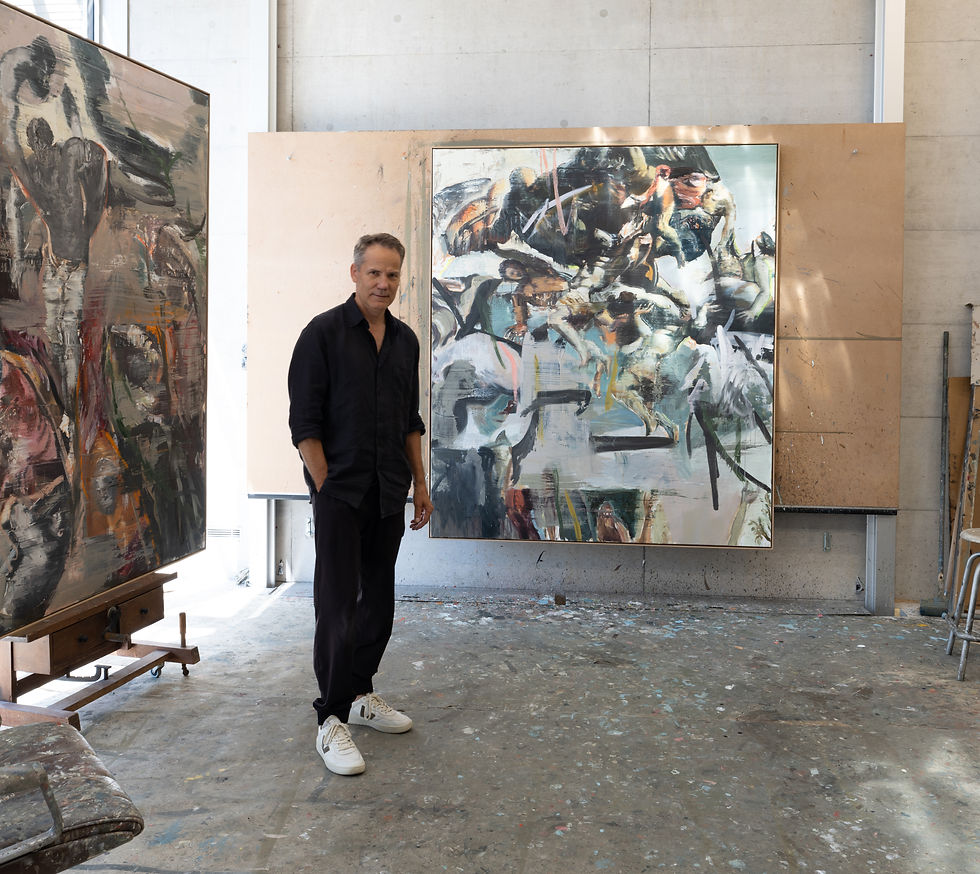
Andy Denzler in his Studio
@All images courtesy of Andy Denzler.