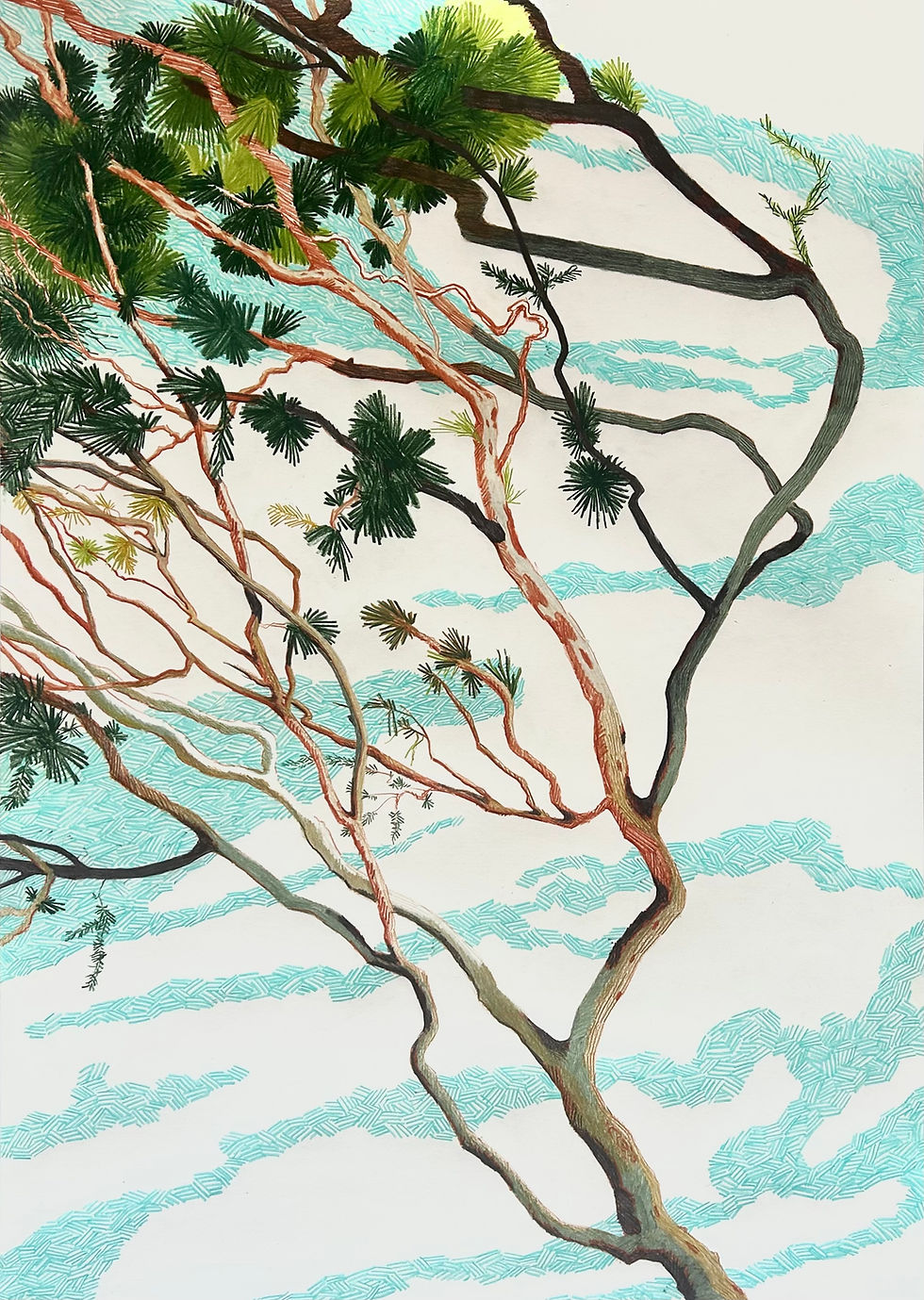
Cecily Brown - The Uncertainty of Looking
Updated: Aug 28

There are artists who paint what they see, and artists who transform the act of seeing itself. Cecily Brown belongs unmistakably to the second category. Her paintings occupy an extraordinary space between figuration and abstraction, where bodies, landscapes, animals and fragments of everyday life emerge from layers of colour and gesture, only to dissolve again before the eye can fully grasp them.
Born in London in 1969, Brown moved to New York in the 1990s and quickly established a distinctive position within contemporary painting. Her canvases are sensual, physical and often overwhelming. Thick passages of paint collide with delicate marks, luminous colours emerge from darker surfaces, and apparently chaotic compositions reveal themselves slowly. Nothing is given to the viewer immediately.
This is precisely where the power of her work begins.
Brown does not simply depict a subject. She creates an experience of discovering it. A figure might appear within an apparently abstract passage, a landscape can become almost indistinguishable from a body, while fragments of movement seem suspended between recognition and disappearance. Her paintings ask the viewer to remain with them, to allow meaning to emerge gradually rather than demanding an immediate answer.
Her relationship with art history is equally fascinating. Brown's work carries echoes of the Old Masters, modernist painting, popular culture and the long tradition of the nude, but these references are never presented literally. They are absorbed, fragmented and transformed into something intensely contemporary. The history of painting is present in her work, but it is never allowed to become a limitation.
There is also a profound sensuality in Brown's paintings. Flesh, colour, movement and desire are recurring elements, yet her work never feels simply erotic or decorative. Beauty is constantly interrupted by uncertainty, darkness and ambiguity. What initially appears seductive can become unsettling; what seems abstract can suddenly reveal something unmistakably human.
This complexity was at the centre of Picture Making, her major exhibition at London's Serpentine South, presented from 27 March to 6 September 2026. It was a particularly significant exhibition for Brown, marking her return to a major British institution after more than two decades and bringing together paintings made especially for the Serpentine alongside works spanning more than twenty years of her career. (serpentinegalleries.org)
The exhibition also explored Brown's relationship with the landscape of Kensington Gardens. Nature, woodland paths, flowers and encounters between figures became recurring motifs, allowing the artist to move between observation and memory. The surrounding park became almost an extension of the exhibition itself: a real landscape transformed through Brown's imagination into something more ambiguous and dreamlike.
This connection between the physical world and the imagined one is fundamental to her practice. Brown does not seem interested in reproducing reality exactly as it appears. Instead, she captures the sensation of experiencing it, the fleeting impression of a body, the movement of leaves, the intensity of sunlight, the memory of an encounter.
Her drawings and monotypes reveal the same sensitivity in a more intimate form. They demonstrate an artist constantly thinking through images, allowing lines and gestures to develop with an almost instinctive freedom. Across every medium, there is the same desire to keep the image alive and unstable.
Cecily Brown has become one of the defining painters of a generation that refused to accept the idea that painting had reached its limits. Her work demonstrates that the medium can still be sensual, difficult, beautiful and unpredictable all at once.
For collectors, her career is particularly significant because her paintings reward sustained attention. They do not reveal everything at first glance, and perhaps that is precisely why they remain so compelling. In an art world increasingly dominated by speed and immediate recognition, Brown creates paintings that ask for time.
And time changes them.
The longer we look, the more the surface begins to open. Figures emerge, colours separate, gestures become visible, and what first seemed chaotic begins to reveal an extraordinary internal order.
Cecily Brown does not give us a world to simply look at. She gives us a world that keeps unfolding.
That is the enduring beauty of her painting and perhaps the reason why, long after leaving the gallery, we continue to see it.