Alexis Mata - The Interview
Updated: Sep 14

SR Looking back at the evolution of your practice, your work has moved through different
forms of image manipulation and distortion, painting, and digital experimentation. Which
elements of your earlier work do you still recognize in what you are creating today, and
which aspects have you felt the need to transform?
AM At the beginning of my career, I was very interested in distorting information. I would intervene in old images, using pictorial details or scanner distortion to change the original information contained in them.
That is where I found a creative thread that I continue to develop today: distortion, glitch, and the
deformation of what we understand as reality. The subjects have changed a lot over time, but this
language of error and distortion has remained an important part of my work and has helped me
develop my own visual language.
SR Distortion, superimposition, sweeping, and pixelation have played an important role in
your visual language. What does distortion allow you to express that a more direct
representation of reality cannot?
AM I have always been interested in finding beauty in distortion. I remember the glitch images that
would appear on television or VHS tapes, or the poor printing quality in comics. Those
imperfections always made a lot of sense to me.
That is where I began looking for those kinds of errors in my own work, eventually creating an
aesthetic that moved away from the traditional, whether in painting, sculpture, or other media I
have worked with.
Today I am experimenting with video as well, looking for that same quality. For example, an image
of a sunset that repeats itself until it becomes a glitch. I feel that our reality is going through
something similar. We are losing a sense of reality and, in a way, moving toward something like
Black Mirror. I find something poetic in that relationship between distortion and the reality we are
living in today.
SR Nature has become an increasingly important presence in your recent work, particularly
through landscapes, deserts, plants, and organic forms. What does nature represent for you
today? Is it a physical reality, an interior landscape, a memory, or a way of questioning our
relationship with technology and reality?
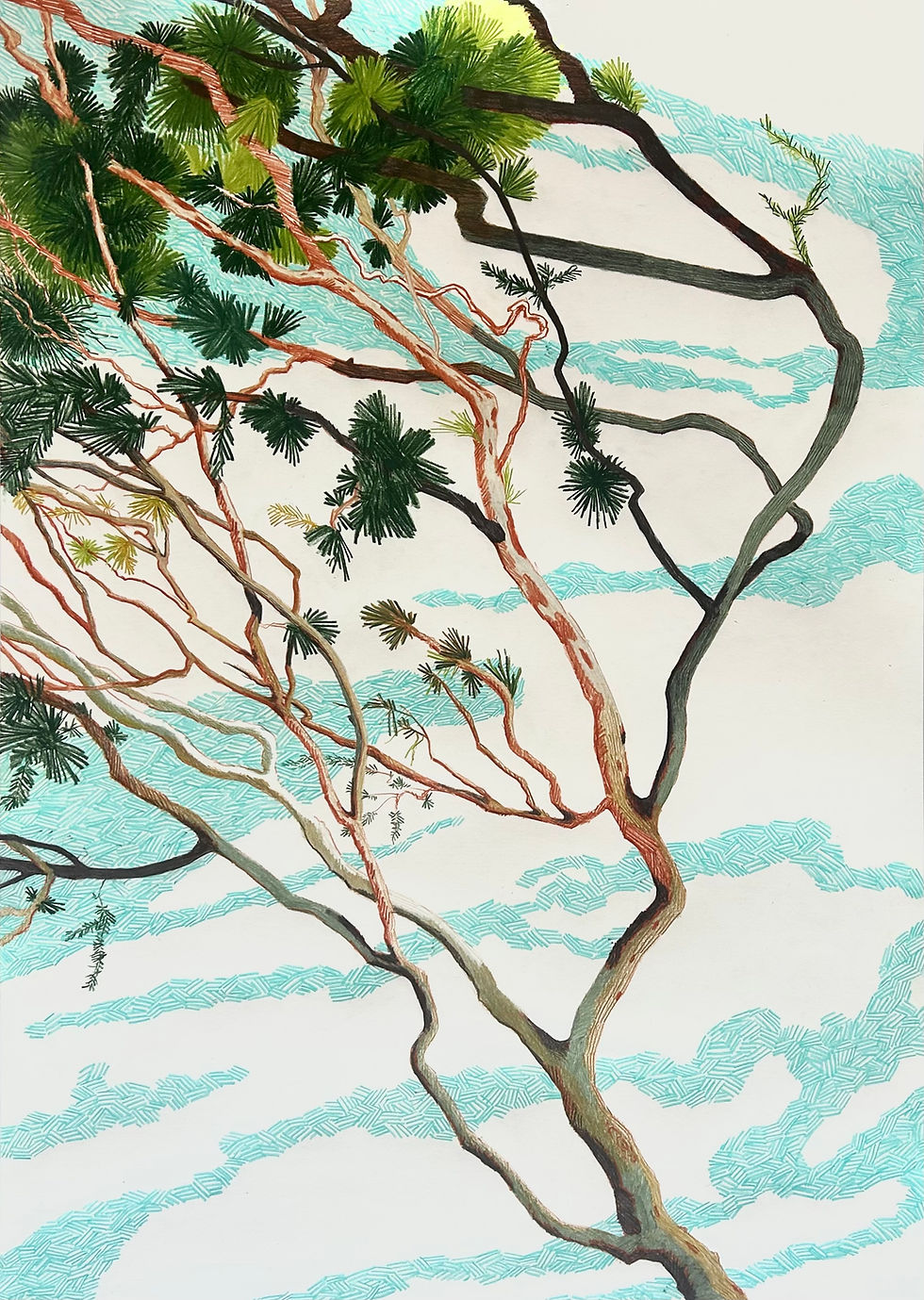
AM Nature has definitely become an important part of my work, but I think it is also something that has developed through a process of observation in my own life. I have realized that observing nature
and landscapes has changed the way I work.
I live in Mexico, a country with every kind of landscape, and I have the opportunity to live in a place
called Tepoztlán, surrounded by mountains and vegetation. Living there has made me pay more
attention to colors, to the way plants grow, and to their different forms. I connect all of this very
closely with dreams.
In some of my exhibitions, I have explored the dreamlike side of things, translating it into surreal
landscapes where mountains repeat themselves, skies and clouds multiply, and plants and cacti
glitch, almost like fragments of a forgotten memory.
That is why nature is so important to me today. Observation has led me toward a more meditative
body of work, where I am trying to bring this idea of error and glitch into pictorial reality. I really
enjoy that process.
At the same time, although I am moving a little away from technology as a subject, it is still very
present in the way I work. My ideas often begin with a pencil sketch, then move into the digital
world, and eventually return to something physical and painterly. I think that return from the digital
to the physical is also a kind of distortion of contemporary reality, because today we see almost
everything through screens. In a way, it feels as if we are living inside Black Mirror.
SR In Tiempo Vivo, you brought together different phases of your practice around ideas of
time, dreams, narrative, memory, and the inner landscape. Looking back at that exhibition
today, what do you consider the most significant transformation in your artistic research?
AM In Tiempo Vivo, I brought together four series that I made between approximately 2017 and 2024.
The title comes from a play on the expression “tiempo muerto,” which in Mexico we use to describe
wasted time, time that you did not use or did not take advantage of. In that first solo exhibition I had
in a museum, I wanted to play with that idea and turn it into “Tiempo Vivo,” because all the work I
had made during those years represented a period of time that had actually been very alive and
constantly evolving.
Bringing those series together allowed me to look back and see how my work had changed, both
technically and conceptually. But what struck me most was realizing that I am now much more
focused on observing my inner self. It is almost as if my own mind has become a landscape, a kind
of inner landscape where I can experiment with my feelings and express them in different ways.
I think one of the biggest changes has been allowing myself to become more poetic and to pay
much more attention to dreams and the dreamlike. I have also become more interested in
connecting with myself under different circumstances, whether through psychedelic experiences or
simply through everyday reality. As a Mexican, I feel we have a cultural background that is very
connected to the surreal, and that has naturally led me deeper into that part of my work.
When I started my career, my work was much more focused on social criticism and, at times, had a
much darker character. Today I feel more at peace with myself, and I try to let that transformation
appear in my paintings. Painting has become almost like a psychological exercise, where I try to
invite the viewer to enter the paintings and the ideas behind them. Nature has become a language
for my own psyche.
I also think I have learned to give myself more freedom to play with ideas, but in a more conscious
way. I feel that I have grown a lot in the way I develop my ideas, and that is probably one of the
transformations I value most in my work.
SR You have presented your work in very different contexts, from museums and cultural
institutions to galleries in Mexico, the United States, and internationally. Which exhibition or
project has been particularly meaningful to you, not necessarily because of its visibility, but
because of what it changed in your way of thinking or making?
AM For me, one of the exhibitions that really marked a turning point was Sueñan las flores que
desaparecen, which I made after the pandemic. At the time, I became very interested in the idea of
vases and ghost flowers. I was locked inside during the pandemic, and many times the only thing I
would see were the flowers on my table slowly dying.
I started thinking about this strange question: do they know they are dead? Or do they somehow
still feel alive? To me, they became like ghosts. I built an entire body of work around that idea, also
looking at the tradition of Dutch floral still-life painting, but taking it somewhere much more surreal
and personal.
That exhibition was very important to me because it took my work in a different conceptual
direction and opened up a body of work much more connected to nature. It also changed the way I
visualized my paintings and thought about my work. I started playing more with fantasy and with
the idea of building a story from a personal experience, from something ordinary that could
suddenly become something else.
The pandemic was chaotic for everyone, but for me personally, I felt as if we were constantly close
to death, as if we were all about to disappear and had somehow become ghosts walking around.
I think that was when I began to understand that nature could become an extension of my own
experience. The flowers stopped being just flowers. They became a way of talking about time,
fragility, disappearance, and our own existence. From that point on, nature stopped being simply a
subject, in my work and became a way of talking about ourselves.
SR In Formas Oníricas, you transformed poetic texts and personal contemplations into
images through artificial intelligence and subsequently reinterpreted those images through
oil painting. What does this process reveal to you about the relationship between
technology, imagination, and artistic authorship?
AM It was my first real encounter with artificial intelligence. I started playing with it, basically in the
same way everything begins in my work: through experimentation and play, and then allowing the
ideas to develop from there.
With Formas Oníricas, I wanted to bring several of these things together. At the time, I was reading
the Argentine poet Alejandra Pizarnik and Octavio Paz. I also remember reading about Japanese
haikus. That research became a starting point for writing short texts and using them as prompts for
artificial intelligence. From there, I started experimenting.
I was very interested in the idea of translating my dreams into just a few words, finding a very short
way of describing them and then using those words to generate an image through AI. I would then
work on those images digitally in Photoshop and Illustrator, and eventually translate the whole
process back into painting.
When it comes to authorship, I think it is important to distinguish between inspiration and copying.
For me, inspiration means taking an idea, an experience, or a reference and allowing it to take you
somewhere else. Copying is different: it is reproducing someone else's work without really
transforming it.
With Formas Oníricas, I never intended to create images based on another artist's work. The idea
was never to copy or look for a specific reference. I wanted to leave the process open and let the
artificial intelligence generate the images, and then I would begin playing with them myself.
Many times I would combine two, three, or even four different images generated by AI. By mixing
and transforming them, the final result became completely my own. That is where I feel authorship
begins to belong to my idea. I am not taking an existing image and simply painting it. That has
never been my process.
The fun is in playing with the images, combining them, and making them speak about you. The
final image becomes something completely your own as an artist.
And when it comes to authorship, I think it is very difficult today to have complete copyright
protection over your work. I remember that, on a trip to New York, I found a design in a store
belonging to a very famous clothing brand that was actually a design I had made. They had copied
it. When I tried to fight it, the lawyers told me that my image was already all over the internet and
that it would be very difficult to win the case. To me, that is a very clear example of the moment we
are living in.
I think the best copyright an artist can have is the way they think, the way they work, and ultimately
their own style. Today I feel very confident that it would be difficult for someone to truly imitate one
of my paintings or pieces, because they come from a very intimate place.
And of course, there will always be people who want to copy. At the beginning of my career,
references were a much bigger part of my work. Now, being older and more mature, I feel much
more confident about what I think and what I feel, and that gives me the freedom to create what I
create.
But I am not against copyleft either. I think it depends on how it is used. There are people who
simply copy things, and I think that is a problem. But when I see a student send me a painting
based on one of my works, or even something that is very close to it, and they tag me, it actually
makes me happy. I don't get angry. I think there is something beautiful about seeing that.
In the end, I think it depends on the intention and the context. I am not saying that copying is
always right, but I do believe there are different ways of using and reinterpreting images.
SR Sublime Paraíso presents nature through desert landscapes, cacti, transformation, decay,
and regeneration. What do you feel you have not yet explored through your relationship
with nature, and what would you still like to discover or express through it?
AM Sublime Paraíso came directly after the presentation I had in New York of Fata Morgana. I was
very interested in the meaning of Fata Morgana and in the way the mind begins to create images in
a desert landscape, in a place where there seems to be nothing. I was fascinated by the idea of the
mind creating these oases, these images that are not really there, and that became the starting
point for the series.
Then, during one of my trips through Europe, I was in Spain and spent a long time looking closely
at The Garden of Earthly Delights by Hieronymus Bosch. That painting really triggered the idea for
Sublime Paraíso.
For me, it was a very cathartic moment because I wasn't feeling completely confident about the
exhibition or about the way I was working. As an artist, you often have doubts about what you are
producing. Looking at that painting allowed me to let go of some of those doubts and simply start
playing.
I began working with nature from a much more surreal perspective, something I hadn't really
explored before. I started thinking about the transformation of the cactus into a skeletal form,
almost like these beings or gods. In Mexico, there is a very particular relationship with cacti and a
strong symbolic connection to them. I was also interested in the idea that when a cactus dies, it
blooms.
At that time, I wasn't feeling completely well emotionally either, so I started researching these ideas
and connecting them with my own emotional state. That became part of the way I developed the
series.
I really enjoyed the process because of the play with color, the experimentation with images, and
because I also allowed myself to move into sculpture. I created very dreamlike pieces, including a
giant thorn-covered cloud shooting a lightning bolt toward the ground, and a symbolic cactus with a
snake moving upward along it.
These were symbols I had been carrying with me for a long time, but I began bringing them
together piece by piece until they became the exhibition. That process has made me think much
more about nature and about myself.
I still feel that there is so much for me to discover. I don't know exactly where this research will take
me, but I know I want to continue experimenting with other media that can help me develop a body
of work in which these landscapes and elements of nature can become a kind of visual archive of
things we should not forget exist.
There is also a melancholic side to this for me. I think a lot about the destruction of our natural
environment. In Mexico, there is so much destruction of forests and mangroves. And in Tepoztlán,
where I live, there is a cave where the bats are also facing serious problems. It makes me afraid of
what will happen if we continue destroying these places.
I feel that I am trying to build an archive of images, a kind of visual memory, so that we can at least
continue to see these landscapes through paintings, videos, and other forms. I am still trying to find
a creative path to explore this relationship between humans and nature through art.
I don't think I am inventing something new. I am simply experimenting with things I haven't done
before, and I think there is still a lot for me to investigate.
SR Looking towards the future, what direction feels most urgent for your practice today? Is
there an image, idea, landscape, or question that you feel is still waiting to become the
starting point for the next chapter of your work?
AM Yes, I think that in the future I would like to move into filmmaking. I have been writing some early
ideas and sketches for film scripts, where I want to bring together many of my pictorial ideas and
take that body of work toward short films, video art, or video installations.
I still feel like a complete beginner in that area. I didn't study film, but I didn't study painting either,
and that is precisely what makes it exciting for me. I really enjoy working without knowing exactly
where something is going to end up, because there is no established path and that gives me the
freedom to experiment.
Right now, I am also trying to work more with real images. I have been recording a lot of sunrises,
rain, plants moving, and small moments happening around me. I am collecting all these images as
a kind of personal archive and trying to figure out how to turn them into a collage or a video glitch
that could eventually become a piece, a short film, or an installation.
I think that is what I am exploring right now. I don't know exactly where it will take me, but that
uncertainty is also part of what I enjoy about the process. At the end of the day, experimentation
has always been a fundamental part of my work.
I am also completely obsessed with music and films, so I feel that my work is gradually moving
closer and closer toward that world.
Hopefully, soon we will have a film to show you.
Thank you very much.