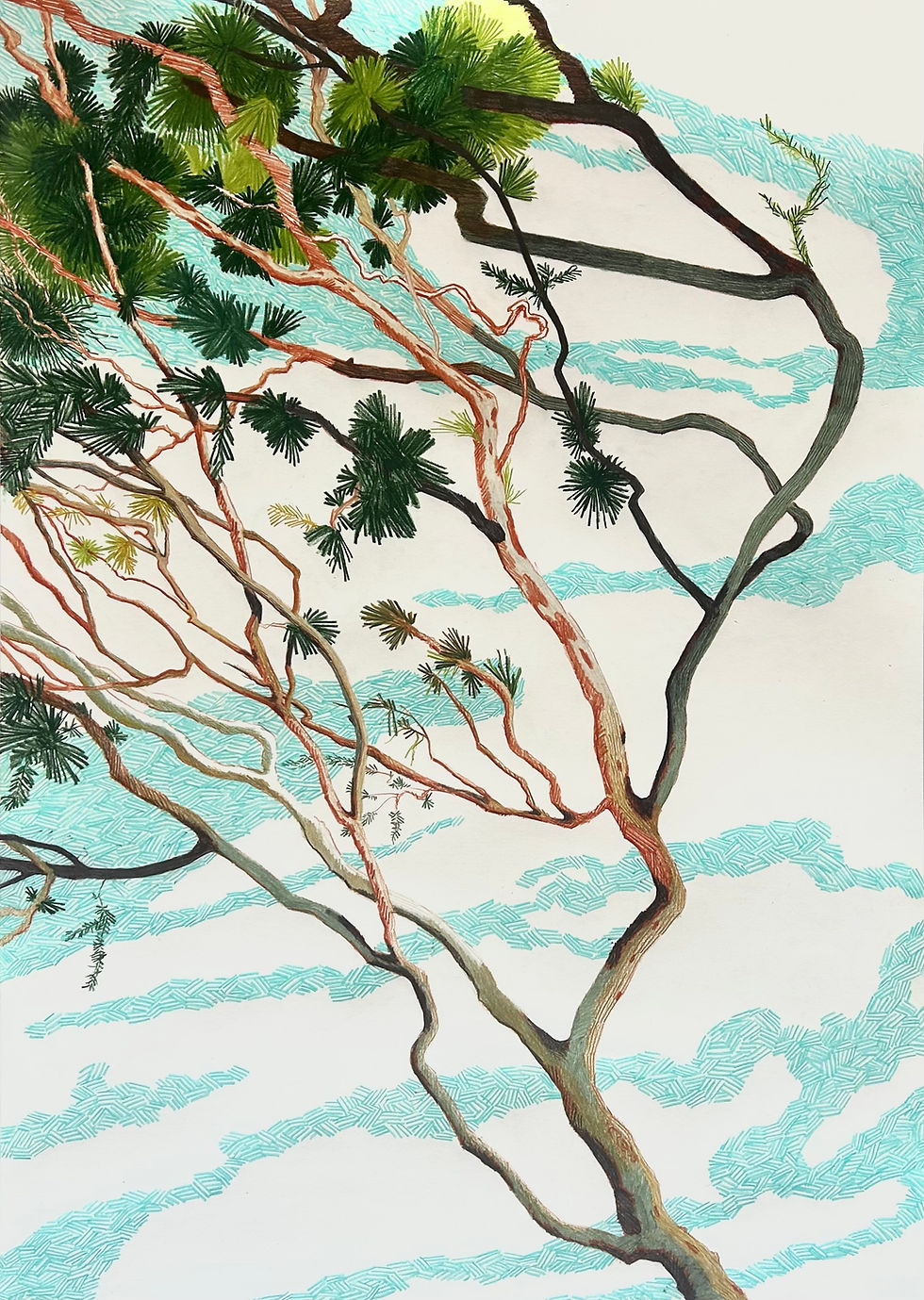
David Hockney - The Art of Looking

There are artists who spend their careers trying to define a style, and then there are artists who spend their lives trying to see the world differently. David Hockney belongs unmistakably to the second category.
Few artists have explored the possibilities of looking with such extraordinary freedom. Across more than six decades, Hockney has moved between painting, drawing, photography, printmaking and digital technology, constantly questioning the boundaries of his own practice. His career is not simply a succession of iconic images, but an ongoing investigation into light, colour, perception, time and the act of seeing itself.
Born in Bradford in 1937, Hockney emerged in London during the 1960s and quickly became one of the defining figures of British Pop Art. Yet the label never fully explained him. From the beginning, there was something much more personal beneath the bright colours and seemingly effortless compositions. Hockney was interested in people, places and everyday life, but above all he was interested in how we experience them.
California became one of his great subjects. Its swimming pools, palm trees, houses and brilliant sunlight offered him a new visual language, one in which colour could become almost physical. His famous pools are immediately recognisable, but their apparent simplicity hides a sophisticated exploration of surface, reflection and movement. Water becomes an image of light itself, constantly changing and impossible to completely capture.
Light, perhaps more than any other subject, runs through Hockney's entire career. It transforms ordinary landscapes into extraordinary experiences. A room, a road, a tree or a swimming pool can become monumental simply because of the way the artist chooses to look at it.
But Hockney never accepted that there was only one correct way to see.
His fascination with perspective led him to experiment extensively with photography, producing his celebrated photographic collages by combining multiple images taken from different viewpoints. Rather than freezing a moment, these works attempt to reconstruct the experience of actually being present: moving, looking around, remembering. Time becomes part of the image.
Decades later, Hockney would embrace the iPhone and iPad with the same curiosity. For him, technology was not the opposite of painting. It was simply another instrument with which to explore perception. His digital drawings demonstrated that an artist could adopt a completely new medium without abandoning the fundamental principles of observation, colour and composition.
This refusal to remain still is one of the most remarkable aspects of his career.
As his work evolved, Hockney repeatedly returned to the landscapes of Yorkshire. The countryside of his childhood became an enormous subject in itself: roads disappearing into the distance, trees changing with the seasons, fields, skies and shifting weather. What might appear ordinary to another eye became, in Hockney's hands, an extraordinary theatre of colour and movement.
There is a profound optimism in this way of working. Hockney does not need spectacle to create wonder. He looks closely at the world and discovers that it is already full of it.
His portraits reveal another side of this philosophy. Friends, artists, lovers and people close to him are often depicted with remarkable directness. There is little sense of theatrical disguise. Instead, Hockney attempts to capture presence, the particular energy of a person sitting in a room, looking back at the artist.
This is why his work continues to feel so contemporary. Hockney's great subject is not a particular decade, place or aesthetic. It is curiosity.
At a time when contemporary art can sometimes become obsessed with novelty, Hockney offers a different kind of radicalism: the idea that looking carefully at the world can still be revolutionary. He reminds us that technology may change, artistic movements may come and go, and visual culture may become increasingly complex, but the fundamental experience of seeing remains endlessly fascinating.
For collectors, his career offers an equally compelling lesson. Hockney demonstrates that an artist does not need to repeat the formula that first made them successful. The strongest careers are often those that continue to evolve, question themselves and remain open to unexpected possibilities.
After more than sixty years of making art, David Hockney still looks at the world as though he has only just discovered it.
And perhaps that is his greatest achievement.
He has not simply taught generations of viewers how to look at his paintings.
He has taught us to look again