Five Artists to Watch
Five contemporary practices that deserve attention
Within the contemporary art landscape, there are artists who deserve to be followed not simply because of the growing attention surrounding their work, but because of the quality and individuality of the practices they are developing. For a collector, following an artist means first understanding their language, observing how their work evolves and becoming familiar with the path they are building over time. We have selected five artists whose approaches are very different, each developing a distinctive position within the contemporary scene.

Andreas Zampella, born in Salerno in 1989 and based in Milan, develops a practice that challenges the traditional boundaries of painting through installation, sculpture, objects and constructed environments. Trained at the Academy of Fine Arts of Naples, Zampella frequently incorporates elements of theatre and scenography to create spaces in which reality and representation enter into dialogue. His practice is distinguished by a strong attention to the spatial and material dimensions of the artwork, allowing painting to extend beyond the traditional surface of the canvas. In 2023, he participated in Quotidiana at the Museo di Roma – Palazzo Braschi, a project by the Quadriennale di Roma dedicated to contemporary Italian artistic practices.

Guo Qikai is a painter born in Kunming in 1994 who developed his artistic education in Italy, at the Academy of Fine Arts of Venice, where he completed his Master’s degree in Painting with honours in 2022. His practice develops through images suspended between reality and imagination, in which figures, landscapes and enigmatic forms create highly evocative atmospheres. Memory, dreams and psychological states become central elements of a painting that does not seek to offer an immediate narrative, but instead leaves room for the viewer’s interpretation. His exhibition history includes presentations dedicated to young artists at the Fondazione Bevilacqua La Masa in Venice, followed by exhibitions in Italy and abroad.

Tatiana Defraine’s practice focuses on figurative painting and the psychological possibilities of the image. Her works often depict figures immersed in suspended environments, where the narrative deliberately remains undefined. The body, water, intimacy and the relationship between figure and space become tools for constructing quiet and ambiguous atmospheres. Defraine avoids a single narrative interpretation, allowing colour, composition and the presence of her subjects to determine the emotional tension of each work. Her practice has been presented in several exhibitions, including Figures du Soir at Acappella in Naples in 2026.
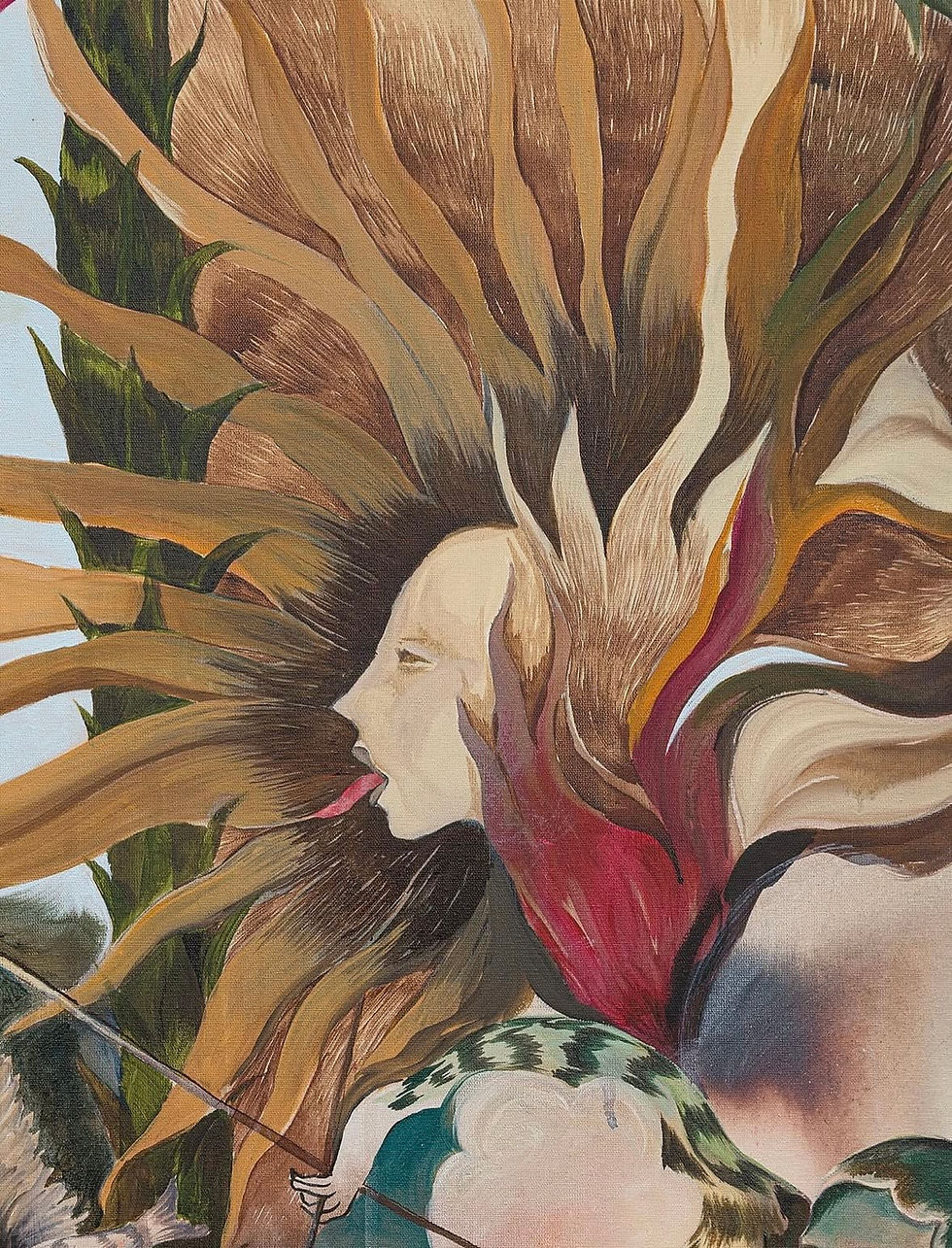
Luciano Maia, born in Santarém, in the Brazilian state of Pará, in 1987 and now based in São Paulo, develops a practice spanning painting, collage, ceramics and illustration. His work is deeply connected to the personal and collective memory of the Amazon and to the cultural layers of the territory in which he grew up. Mythology, folklore, identity and imagination coexist within compositions populated by hybrid figures and symbolic forms. His practice constantly moves between experience and invention, using the image as a means of constructing new narratives around memory and belonging. His work has been presented in exhibitions in Brazil as well as internationally.

Vicky Polak works across photography, film and visual anthropology, developing a practice centred on memory, identity and the ways in which images and narratives shape our perception of reality. Her background in cinema and anthropology informs an approach that combines documentary research with experimentation. In her analogue photography, she also employs double exposure, layering different images to create unexpected relationships between people, places and moments. The result is a form of photography that goes beyond documentation and becomes a tool for investigating memory and perception. Her exhibition history includes several international projects and recent presentations in Venice and London.
For a collector, following artists at this stage means looking beyond the immediate visibility of the market and paying attention to the development of a practice. Exhibitions, institutional recognition, gallery relationships and critical attention can all provide useful context, but they should complement rather than replace the most important element: the work itself. The strongest reason to follow an emerging artist is ultimately the same reason to collect contemporary art at all the feeling that there is something in the work that deserves to be looked at again.


