Mathieu Cherkit - Tendrement

Semiose is delighted to open its post-summer break program with a major
exhibition by Mathieu Cherkit at 44, rue Quincampoix. Featuring 15 hitherto
unseen works, this first collaboration offers an overview of the work of one of the
leading figures of the revival of figurative painting in France.
This overview of his painting could also be seen as an overview of his life in
general, given how closely his work is linked to his daily and family life. The
interior scenes painted by Mathieu Cherkit are disarmingly familiar, exploring
domestic life in all its triviality. Even in his self-portraits and his street, garden
and plant paintings, we are struck by a strange sense of déjà vu. Yet, despite his
rendering of the smallest details down to the anecdotal, his painting seems
suddenly to shift into a more historical and metaphysical dimension: historical,
when he cites his predecessors in the field of painting, in particular those who
produced abstract works, even though his own are viscerally figurative;
metaphysical, through its temporal and spatial kaleidoscope, disrupting
perspectives and intersecting planes in the manner of the Cubists or the
Expressionists. Images by Fritz Lang and F.W. Murnau—and 1920s
Expressionist cinema in general—spring to mind when viewing the destructured
planes and distorted perspectives in Mathieu Cherkit’s paintings: the viewer’s
gaze is swept into a kind of hypnotic vertigo, for example in Matière Noire
(2026), where the stove is seen both from above and slightly from one side.
The atmosphere that suffuses these painting also resembles that of film noir.
With this painter, more than almost any other, one must be wary of his images.
The calm and tranquility of the subjects harbor all the elements of a trivial news
story. Cherkit’s scenes share the banality of those described in forensic reports;
the various objects resemble pieces of evidence, particularly when they are
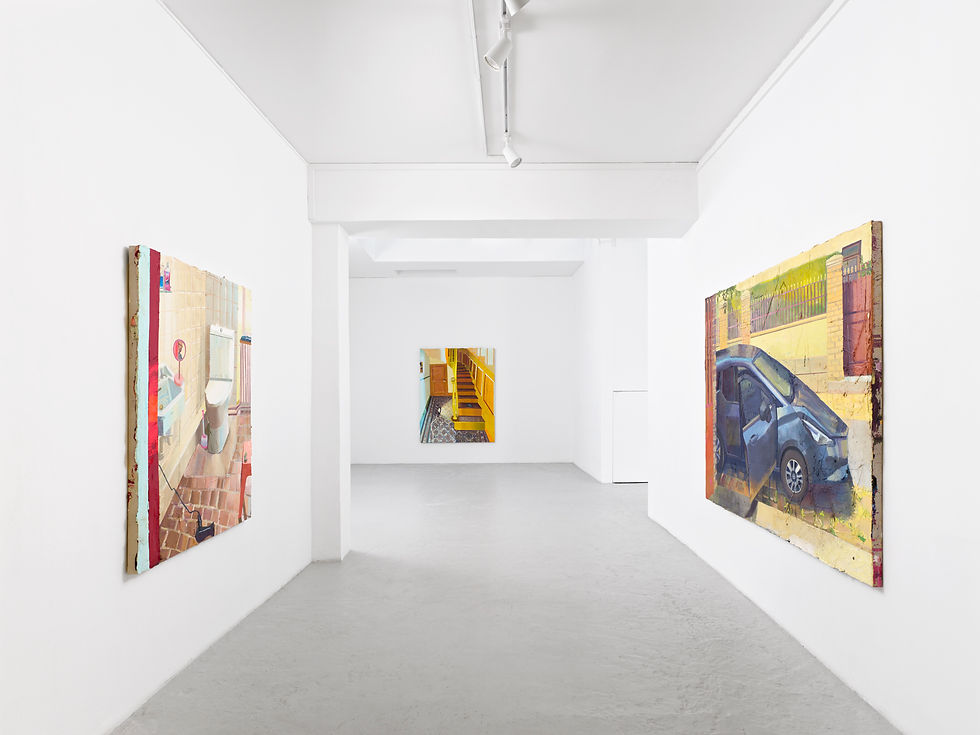
found on the floor, such as is the case with the hair-dryer in La Toilette (2026) or
the men’s underwear in Sleepy Solo (2026).
Cherkit’s paintings tells stories because it triggers the imagination. It makes use
of the same techniques employed in suspense films, planting clues here and
there and paying obsessive attention and the precision of a detective to certain
details. The artist manipulates the eye of the viewer in an act of seduction, luring
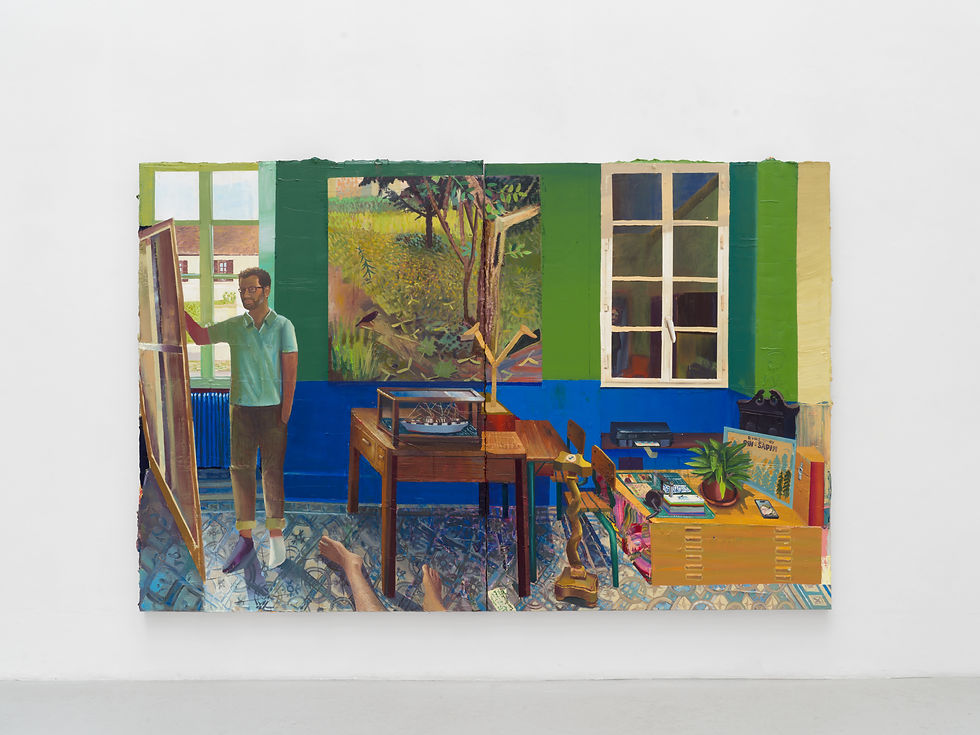
it into imagining all sorts of contexts. In Tendrement (2026), the legs stretched
out at the foot of the painting are more reminiscent of a prone corpse than of an
impromptu snooze. Even the innocent poppy with its bright red flower (Papaver
Rhoeas, 2026) or the bush with its scarlet currents (Ribes Rubrum, 2026) have
something suspicious about them—in the natural world, red is often synonymous
with danger. The Chat Noir (Black Cat, 2026), with its piercing gaze suggests
the same thing, as does the small pool of water in the mud—a view of the river
Orval in the Yonne region, where the artist lives and where one could easily
imagine one of Claude Chabrol’s dramas unfolding.
Through his choice of subjects, Mathieu Cherkit constructs visual and material,
emotional stories. He creates painterly fantasies, where his depictions of
everyday life feign diversions in their narratives, as if to escape from a form of
boredom. Beneath its thick impasto, this painting, captured from life, ultimately
reveals the artist’s tender, playful vision of the banality of everyday life. Through
the act of painting, the commonplace of ordinary life is transformed, acquiring a
renewed sensory presence.





© A. Mole. Courtesy Semiose, Paris.
44, rue Quincampoix, Mathieu Cherkit - Tendrement
August 29
October 31, 2026
The exhibition will be accompanied by an essay by Camille Richert and an
exclusive photo-shoot portraying the artist in his home/studio will provide a
photographic exploration of the spaces that inspire his paintings.