NIGHT MOVES
Five Artists Painting the Night
There is a particular freedom that arrives with darkness. Familiar streets become unfamiliar, architecture begins to disappear, and artificial light takes control of the landscape. At night, reality becomes less certain. For artists, this uncertainty creates an extraordinary opportunity: the world remains recognisable, but it can be reinvented.
Contemporary painting has repeatedly returned to this territory. From urban lights to mysterious landscapes and intimate interiors, these five artists demonstrate how differently the night can be imagined.

Keita Morimoto
Few contemporary painters have made the nocturnal city as distinctive as Keita Morimoto. Born in Osaka and now based between Toronto and Tokyo, Morimoto creates urban scenes illuminated by convenience stores, streetlights, windows and other fragments of artificial light. His paintings often combine contemporary Japanese and North American city life with the dramatic chiaroscuro of Old Master painting. In his After Dark series, empty streets and isolated figures become almost cinematic, suspended somewhere between everyday reality and fiction. The city is familiar, but something about it feels slightly wrong as if we are seeing it at a moment when everyone else has gone home.

Peter Doig
With Peter Doig, darkness becomes memory. His landscapes rarely feel like straightforward observations of a particular place. Instead, they seem to emerge from fragments of recollection, cinema and imagination. Night skies, lakes, snow, trees and isolated figures create worlds that are recognisable but impossible to completely locate. In works such as Milky Way, the landscape becomes almost weightless: the water reflects the sky while the surrounding darkness eliminates any clear sense of distance. Doig's nights are not necessarily frightening. They are simply uncertain, and that uncertainty gives them their extraordinary psychological power.

Hernan Bas
For Hernan Bas, the night offers a stage for fantasy. His paintings frequently feature young men surrounded by strange landscapes, water, vegetation, stars and references to literature, mythology and the supernatural. The figures appear to inhabit a world somewhere between adolescence and fantasy, where reality is never completely stable. Darkness becomes an invitation to imagine rather than a simple absence of light. Bas's recent work continues to explore this mixture of beauty, mystery and ambiguity, creating paintings that feel like scenes extracted from a story whose beginning and ending we never see.

Seth Armstrong
The night in Seth Armstrong's paintings is quieter and closer to home. Working primarily in oil on wood, the American artist constructs meticulously observed scenes of suburban and urban environments, particularly around Los Angeles. Houses disappear into darkness, while windows, streetlights and distant buildings create small islands of illumination. Works such as Nightcap, Downtown Tonight and Night School transform familiar surroundings into something almost dreamlike. Armstrong's landscapes are not empty, but they often feel strangely solitary. The darkness becomes a way of slowing down the world and turning ordinary places into cinematic spaces.
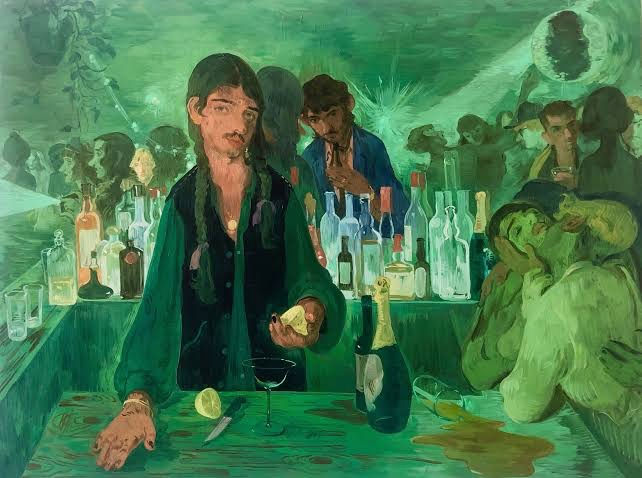
Salman Toor
In the work of Salman Toor, night becomes deeply personal. His paintings frequently depict intimate gatherings, interiors, nightlife and moments of private connection illuminated by candles, lamps, windows and artificial light. Born in Lahore and based in New York, Toor combines references to European art history with contemporary South Asian and queer experience. His nocturnal scenes are simultaneously historical and intensely present. Rather than presenting darkness as something threatening, he transforms it into a space of freedom, intimacy and belonging. The night becomes the moment when social expectations seem to loosen and private worlds can emerge. His 2026 exhibition Someone Like You at The Courtauld in London further demonstrates the importance of this intimate, psychologically charged approach to contemporary painting.
What makes these five artists fascinating is that none of them paints quite the same night. Morimoto finds it in the artificial glow of the city. Doig finds it in memory. Bas turns it into fantasy. Armstrong discovers it in the quiet streets of suburbia. Toor transforms it into a space of intimacy and desire.
Together, they reveal why darkness continues to fascinate painters. Night removes information. It hides details, changes colours and disrupts our sense of scale. But in doing so, it gives the artist something daylight cannot: the freedom to leave things unresolved.
Perhaps that is the real attraction of painting the night. Darkness does not simply conceal the world.
It gives artists permission to reinvent it.


