THE ART OF WATER
Five contemporary artists who turned water into a language
Few subjects are as difficult to capture in painting as water. It has no permanent shape, constantly changes with light, reflects everything around it and can appear transparent, deep, calm or violent within the same moment. Yet for centuries artists have returned to it, trying to translate something that can never truly be still. From Hokusai’s monumental wave to the swimming pools of California, water has continued to offer artists an almost limitless visual language.
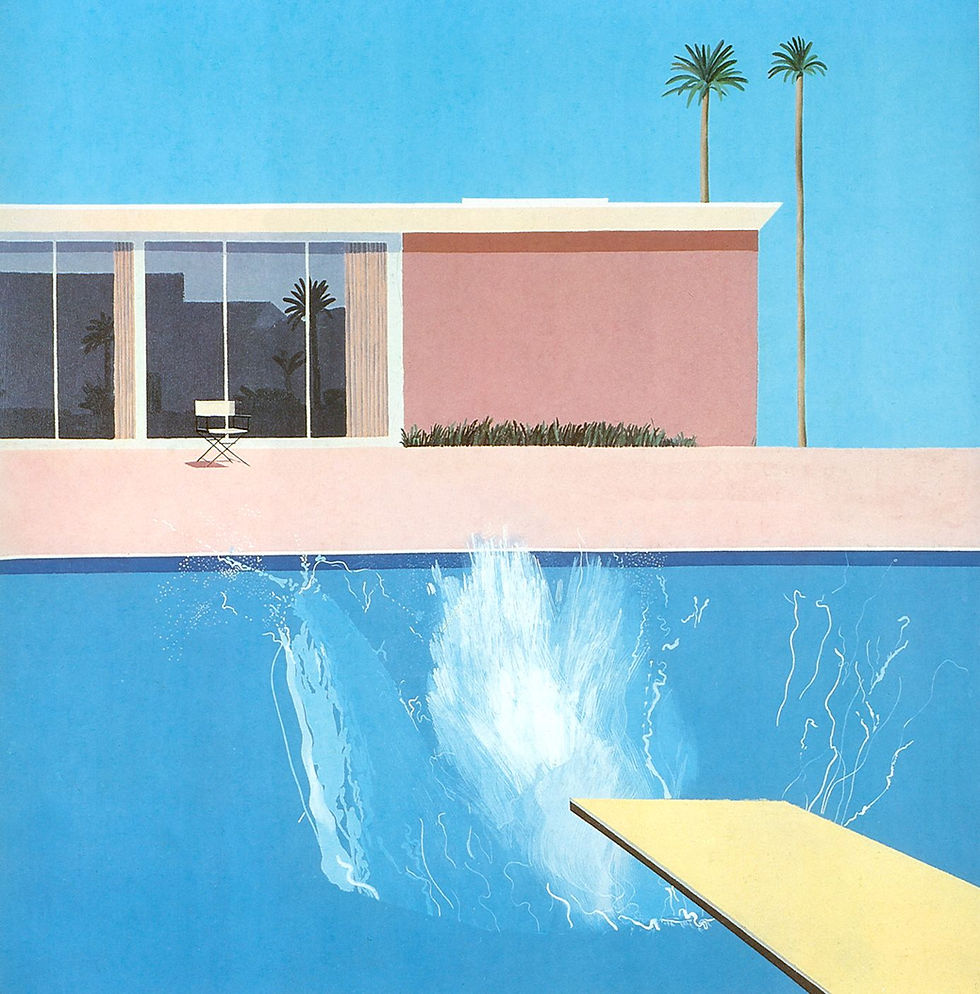
David Hockney transformed the swimming pool into one of the defining images of twentieth-century painting. In A Bigger Splash (1967), now in the collection of Tate, the water itself becomes the event. Everything appears perfectly still except for the enormous splash left by an unseen swimmer. Hockney was fascinated by the difficulty of representing water, particularly its transparency and reflections, and the paradox at the heart of the painting is extraordinary: a moment that lasts only seconds took him weeks to paint.

With Alyssa Monks, water becomes something more intimate. Her paintings frequently place the human body behind or beneath water, glass, steam and other translucent surfaces. Instead of simply depicting someone swimming, Monks uses these layers to distort the figure and interrupt our perception of it. The body becomes fragmented, blurred and partially concealed, creating a tension between realism and abstraction. Water is no longer merely the subject of the painting; it becomes the filter through which we see.

For Ran Ortner, the ocean is something far more physical. A lifelong surfer, Ortner began seriously confronting his relationship with the sea in his painting in the mid-2000s. His enormous canvases translate the energy of waves through dense layers of oil paint, creating surfaces that can feel simultaneously monumental and intimate. In his own words, the ocean mirrors the rhythm of his body and breath. His paintings therefore do not simply describe waves: they attempt to communicate the sensation of being inside them.

Then comes Vija Celmins, who takes water in the opposite direction. Her ocean surfaces are extraordinarily quiet, almost obsessive in their precision. Often eliminating the horizon completely, she reduces the sea to an apparently infinite field of tiny waves and variations. Works such as Untitled (Ocean) and Ocean Surface transform the ocean from landscape into something almost abstract. MoMA describes her ocean imagery as expansive and without boundaries, creating a sense of timelessness and limitless space. Looking at Celmins, it becomes difficult to understand where the water begins or ends. The ocean becomes infinity.

Eric Zener brings us back to the human figure. For more than three decades, water has been central to his practice, particularly through paintings of people swimming, diving, emerging or suspended beneath the surface. Zener describes water as an allegory for refuge, renewal and joy, while the act of entering it becomes a metaphor for transformation. His highly detailed paintings combine technical realism with an almost dreamlike atmosphere, making the boundary between the physical world and an imagined one increasingly difficult to locate.
Five artists, five completely different relationships with the same element. Hockney finds water in the instant of a splash. Monks find it between the viewer and the body. Ortner experiences it as force. Celmins turns it into infinity. Zener sees it as a place of transformation.
Perhaps this is why water has remained such a powerful subject throughout art history. It cannot be possessed by the image. It refuses to stay still. Every artist who paints it is therefore attempting the same impossible task: to give a permanent form to something that exists precisely because it is always changing.
And maybe that is the real fascination of water. We never see the same surface twice.


