Turner Returns to Rome
A masterpiece of the Eternal City comes back to the place that inspired it, before entering the international art market once again
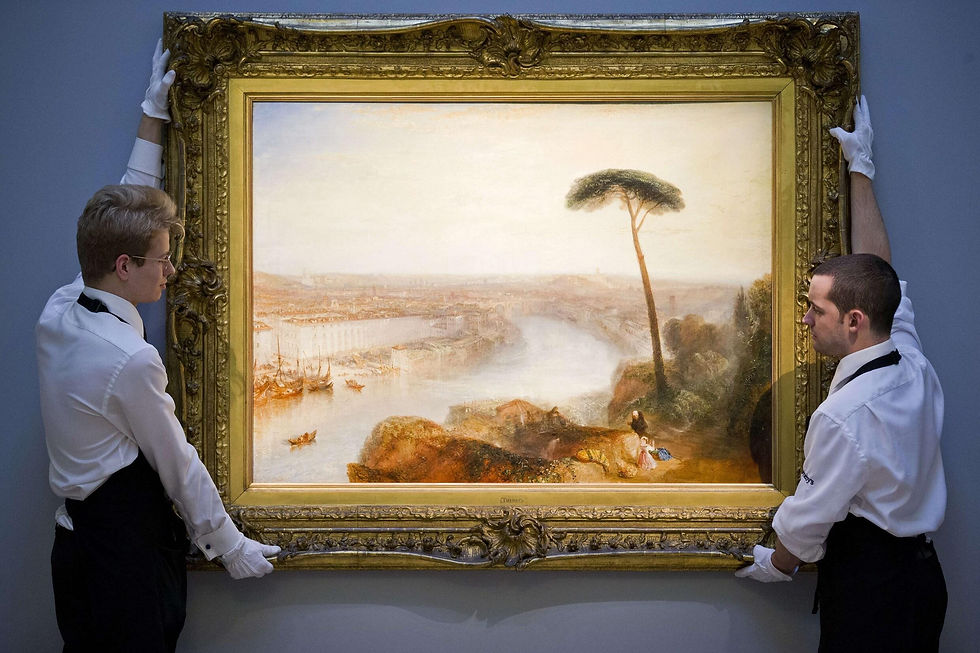
There are paintings that represent a city, and there are paintings that become part of its mythology. J.M.W. Turner’s Rome, from Mount Aventine belongs to the second category.
For three days, from September 29 to October 1, 2026, one of the British painter’s greatest landscapes has returned to Rome, presented at Palazzo Rondinini ahead of its forthcoming sale at Sotheby’s in London. Painted in 1836, the work captures the Eternal City from the Aventine Hill, with the Tiber unfolding through the landscape and Rome appearing in the distance beneath a luminous, almost weightless sky.
The Roman presentation is brief by design. After leaving the city, the painting will travel to Sotheby’s galleries in London, Hong Kong and New York before returning to London for the Old Masters Evening Sale on December 9. Its estimate is around £50 million, a figure that places the work among the most valuable paintings ever offered at auction by Turner.
Yet the estimated price is only one part of the story. What makes Rome, from Mount Aventine extraordinary is the relationship between the painting and the city it portrays.
Turner first visited Rome in 1819 and returned in 1828, remaining until January 1829. His second stay was particularly important for his development as a painter. Rather than simply recording the monuments around him, Turner began to translate his experience of Rome into paintings in which architecture, landscape and atmosphere became inseparable. According to Sotheby’s catalogue, Rome, from Mount Aventine is unusual among his Roman views because of its close connection to the panorama he observed during that second visit.
The composition is remarkably expansive. From the Aventine, Turner looks across the Tiber towards the city. The river, the vegetation and the architecture create a sequence of layers that gradually dissolve into light. Rome is recognisable, but it is not presented as a static topographical document. The city seems to emerge through atmosphere.
This tension between observation and transformation is central to Turner’s work. He belonged to the tradition of European landscape painting, yet his increasingly radical treatment of light and colour pushed that tradition towards something much more subjective. In Rome, from Mount Aventine, the historical city becomes almost an experience of perception.
The painting was commissioned by Hugh Andrew Johnstone Munro of Novar, one of Turner’s closest patrons and friends. Munro acquired a remarkable number of Turner’s works and became one of the most important collectors of his career. Rome, from Mount Aventine was exhibited at the Royal Academy in London in 1836 and remained with the Munro family until 1878, when it was acquired by Archibald Primrose, the 5th Earl of Rosebery, and his wife Hannah Rothschild.
Its provenance is particularly distinguished. The Rosebery family retained the painting for generations, and it remained outside the public market for more than a century. When it finally appeared at Sotheby’s in December 2014, it sold for £30,322,500, establishing a new auction record for Turner. That record remains associated with the same painting today.
Twelve years later, Rome, from Mount Aventine is back on the market.
The circumstances surrounding its return are significant. According to The Art Newspaper, few late Turner masterpieces of this calibre remain in private hands, with the vast majority now belonging to museums. Its rarity, combined with its provenance and exceptional condition, is therefore central to its current valuation.
The condition of the canvas is perhaps one of its most fascinating qualities. Sotheby’s describes the work as being on its original, unlined canvas, with no history of restoration. The surface retains an unusual freshness, including traces of Turner’s working process such as fingerprints, palette knife marks and individual brush hairs.
For a painting created almost two centuries ago, these details offer something extraordinary. They allow the viewer to move beyond the finished image and encounter the physical presence of the artist himself, preserved within the surface of the work.
That physicality is especially striking when the painting is considered in relation to today's art market. Contemporary collecting increasingly places importance not only on an artwork's image, but also on its material history, provenance, condition and authenticity. In Turner’s case, all of these elements converge in a single object whose history stretches from nineteenth century Rome to the global collecting landscape of 2026.
There is also a poetic dimension to the painting’s temporary return.
Rome was one of the great destinations of the nineteenth century Grand Tour. Artists, collectors and intellectuals travelled to Italy to encounter its antiquity, architecture and landscape. Turner was part of that tradition, but his response to Rome was intensely personal. Rather than simply documenting the monuments that surrounded him, he transformed the city into a study of light.
Nearly two hundred years later, the painting has travelled back to the place that inspired it.
For three days, visitors in Rome can stand before the same vision that Turner carried with him from the Aventine into his London studio. The city has changed enormously since 1836, but the relationship between Rome and the painting remains intact.
And perhaps this is what makes the story more interesting than the £50 million estimate.
The market can place a number on a masterpiece. It can trace its provenance, record its previous prices and calculate its rarity. But none of those things fully explains why a painting such as Rome, from Mount Aventine continues to hold attention.
Turner did not simply paint Rome.
He painted the experience of looking at Rome.
That experience, almost two centuries later, is still there.
J.M.W. Turner, Rome, from Mount Aventine, 1836. Oil on canvas. Presented at Palazzo Rondinini, Rome, September 29 to October 1, 2026. Sotheby’s Old Masters Evening Sale, London, December 9, 2026. Estimate: approximately £50 million